Made entirely by hand
Hand-Crafted Watch-Part Collages
Enjoy the unique beauty of these hand-crafted collages made from authentic watch and clock parts.
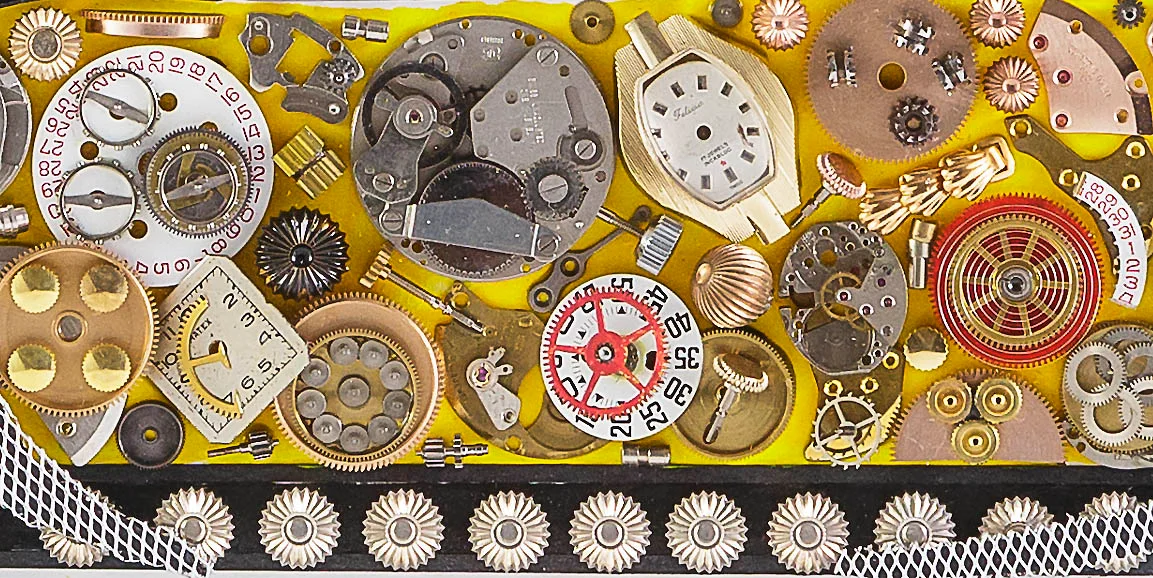
Each collage is hand-made by George Rotenstein in Sydney, Australia. George worked as a professional watchmaker, serving his apprenticeship at J.Farren Price, The Watch Specialist and worked in the watch repair department of the Longines Watch factory in St Imier, Switzerland. Over his extensive career, George diligently collected tens of thousands of authentic Swiss watch parts, which he now uses to create exclusive artworks.
“Being a watchmaker by trade,” says George, “I know the many intricate parts that are used in wristwatches and pocket watches. I love to capture the beauty of these watch parts and their inherent sense of time by depicting antique vehicles that also belong to a bygone era. Just as car enthusiasts spend inordinate amounts of time on their cars, I also spend a lot of time conceiving and creating these collages.”
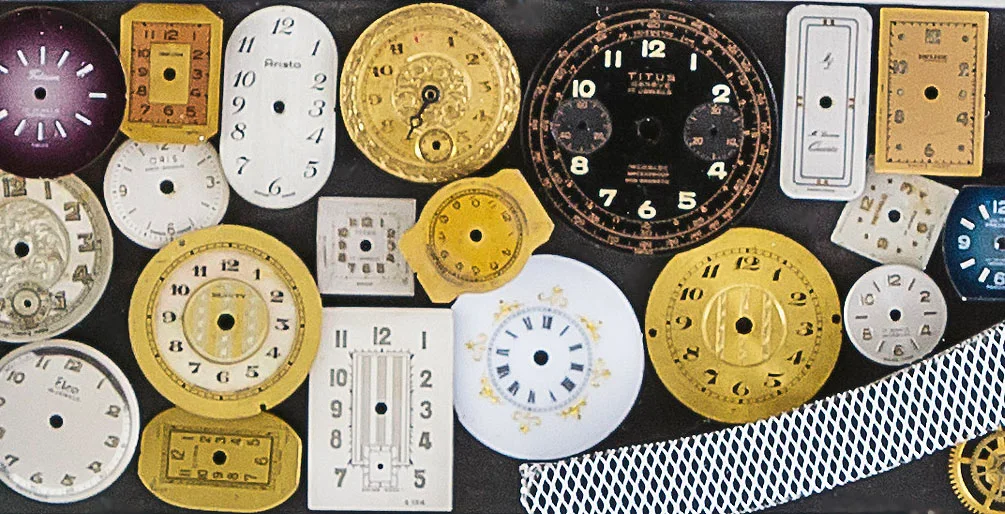
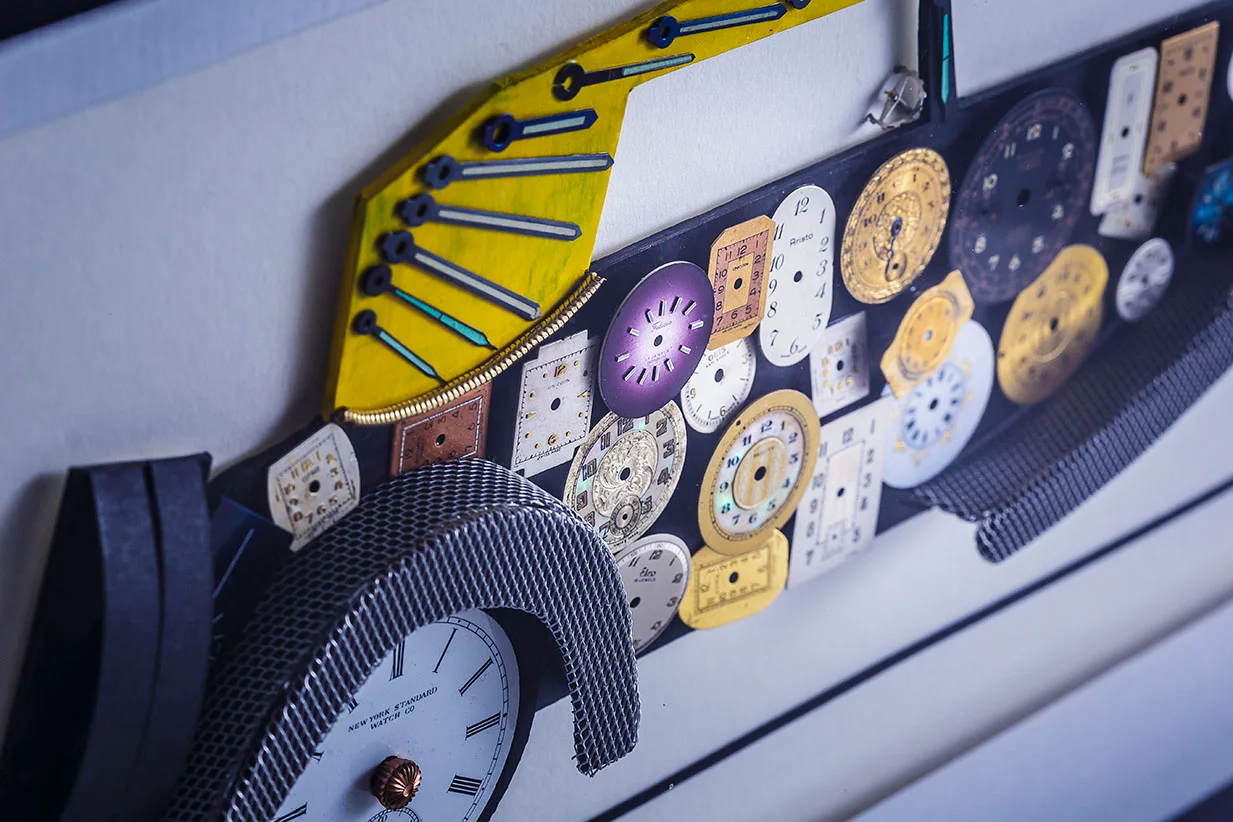
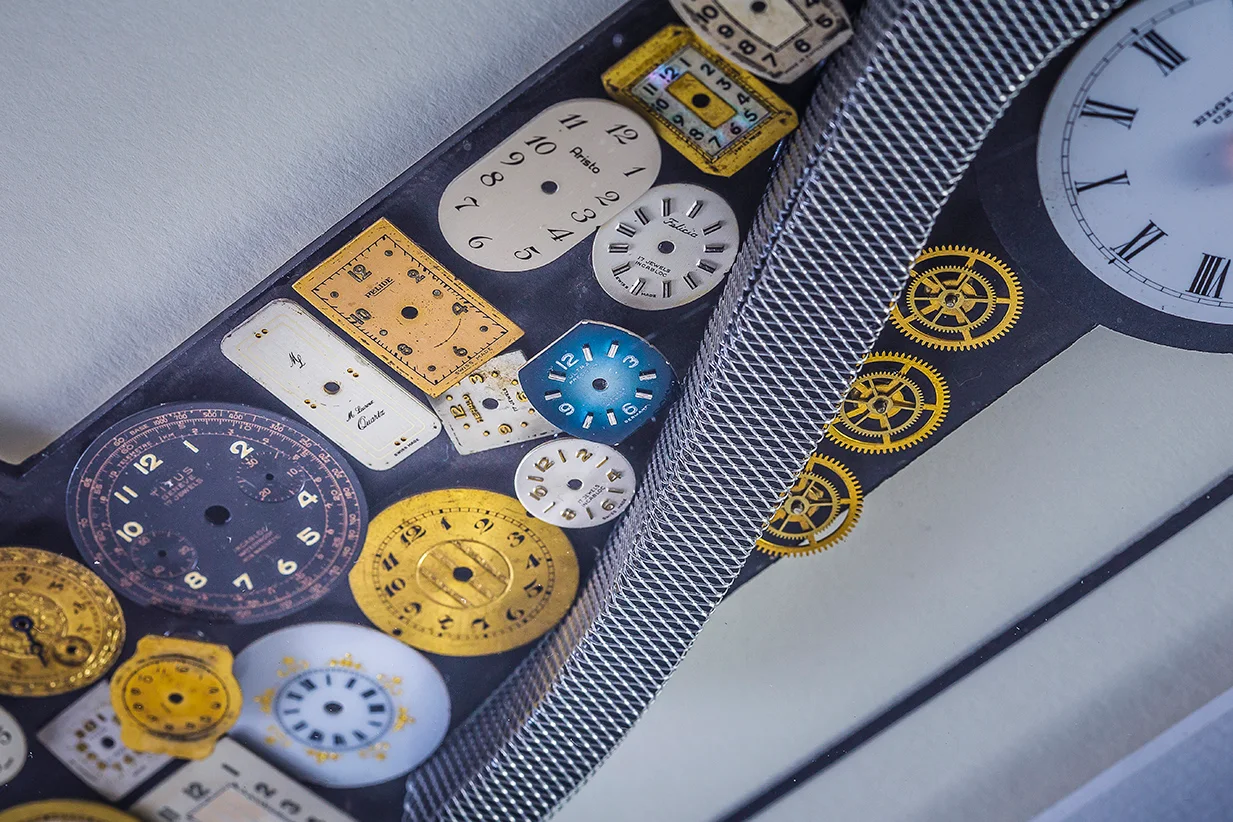
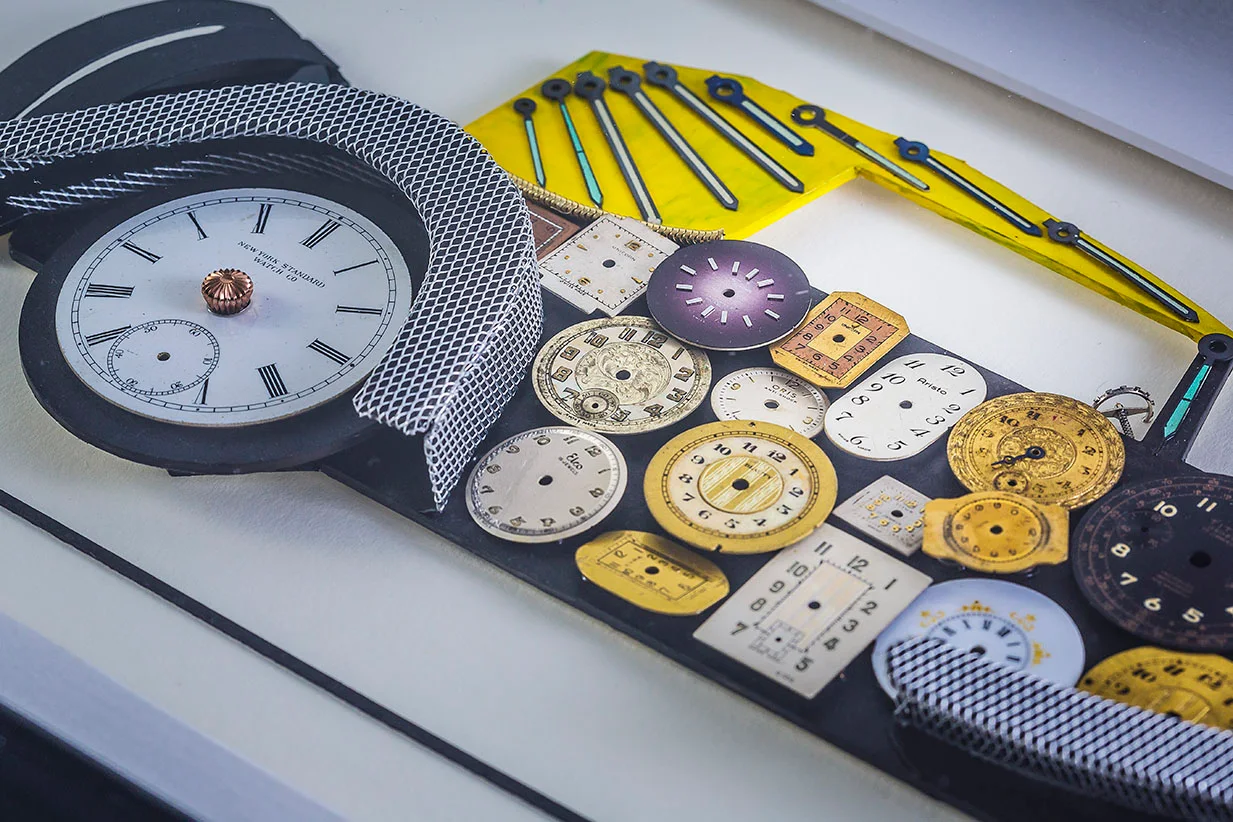
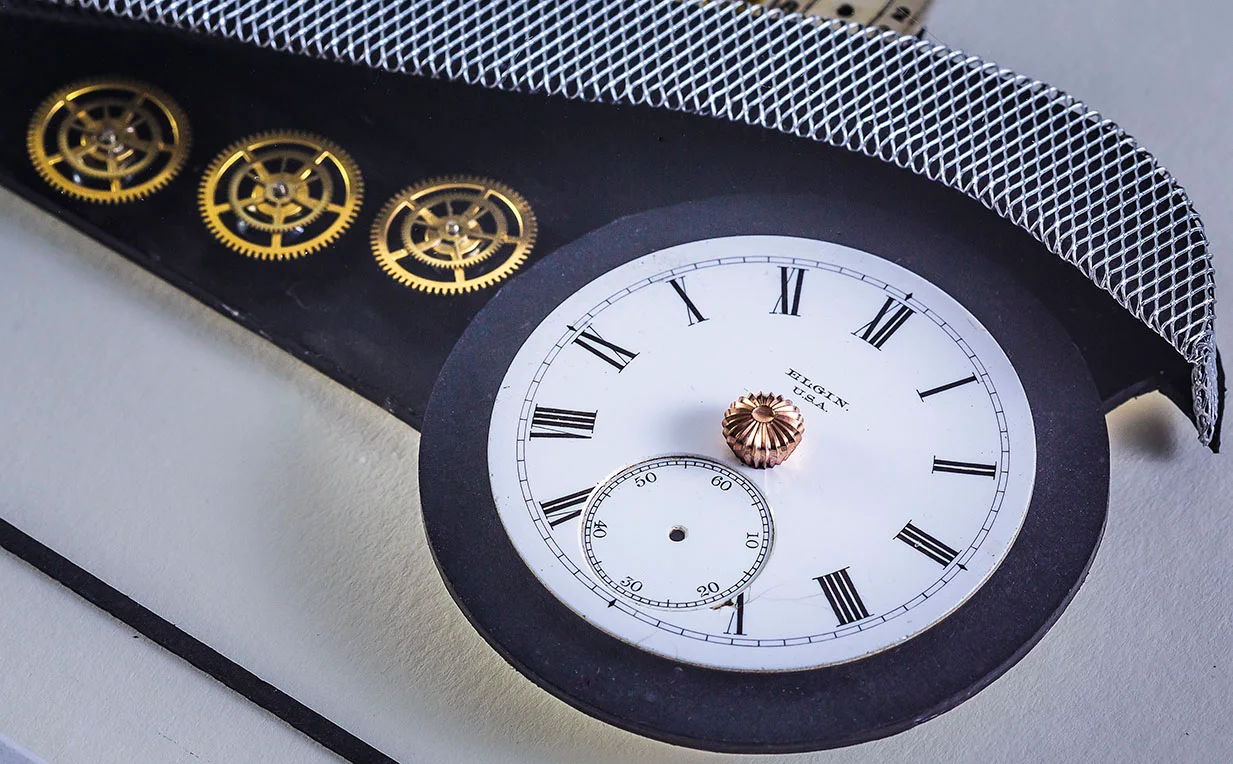
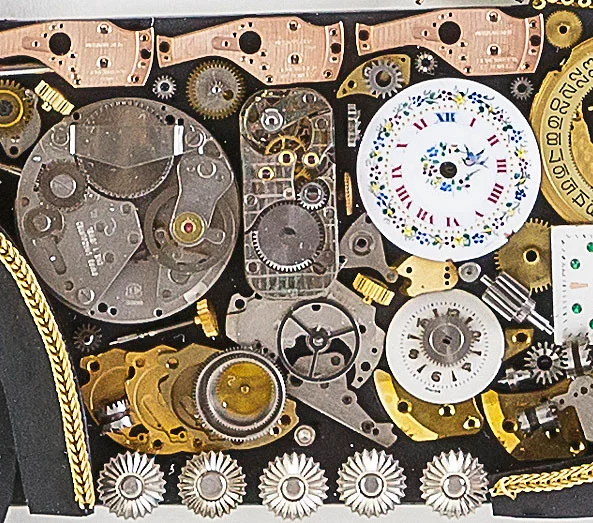
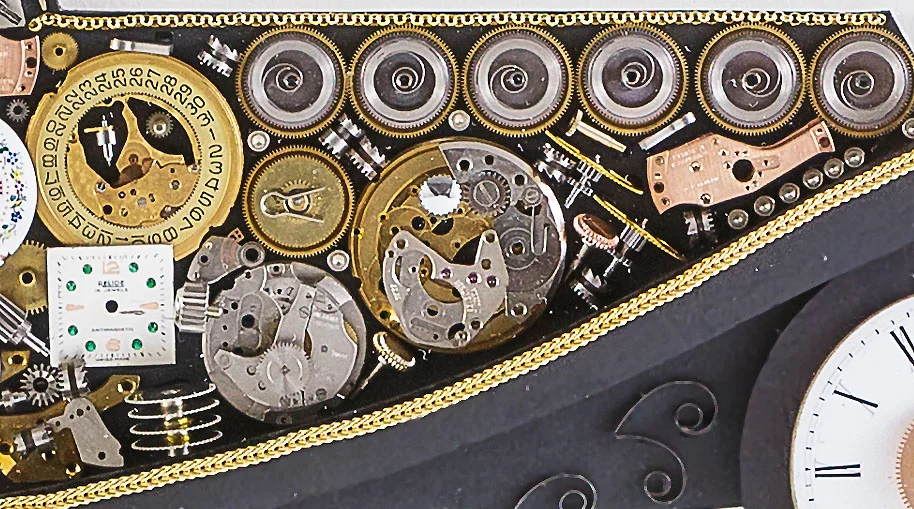
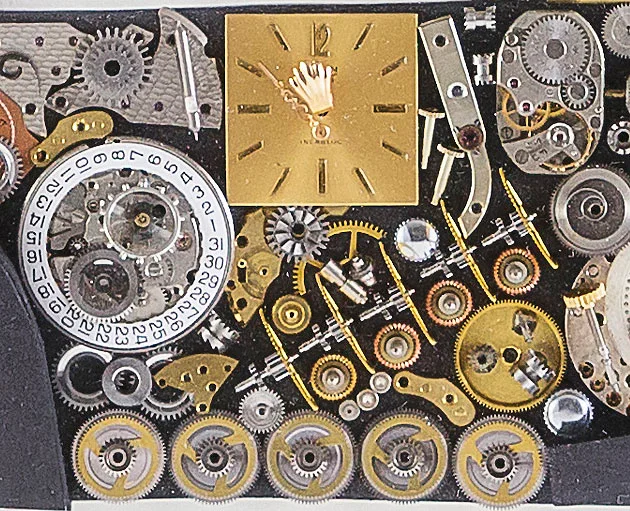
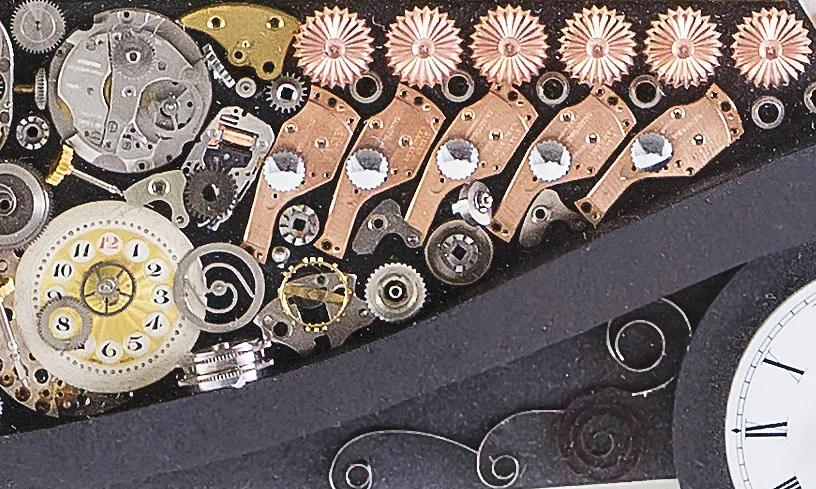
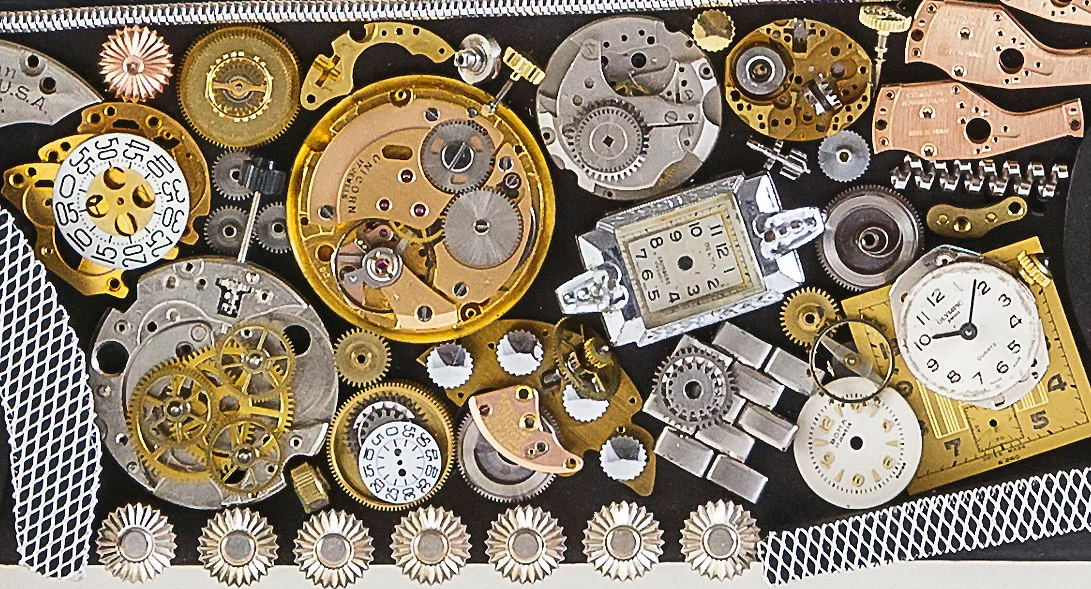
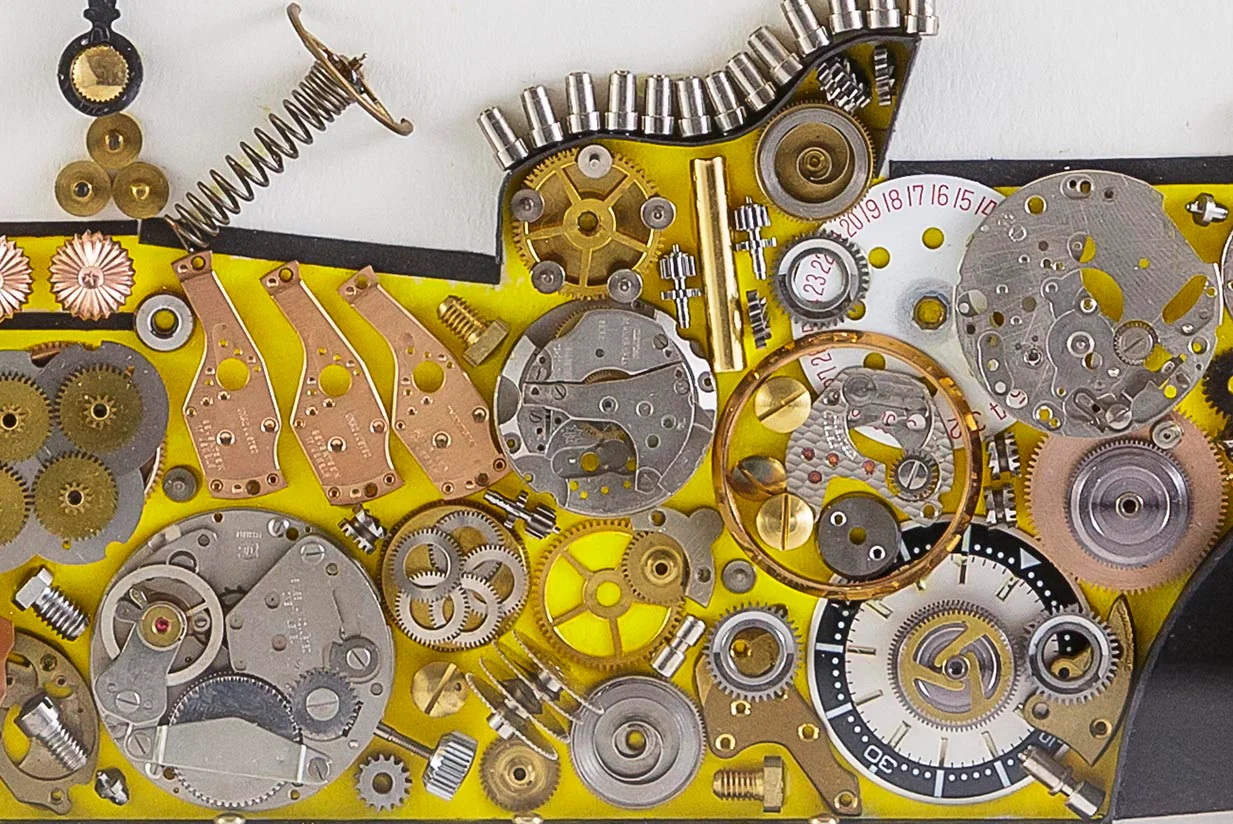
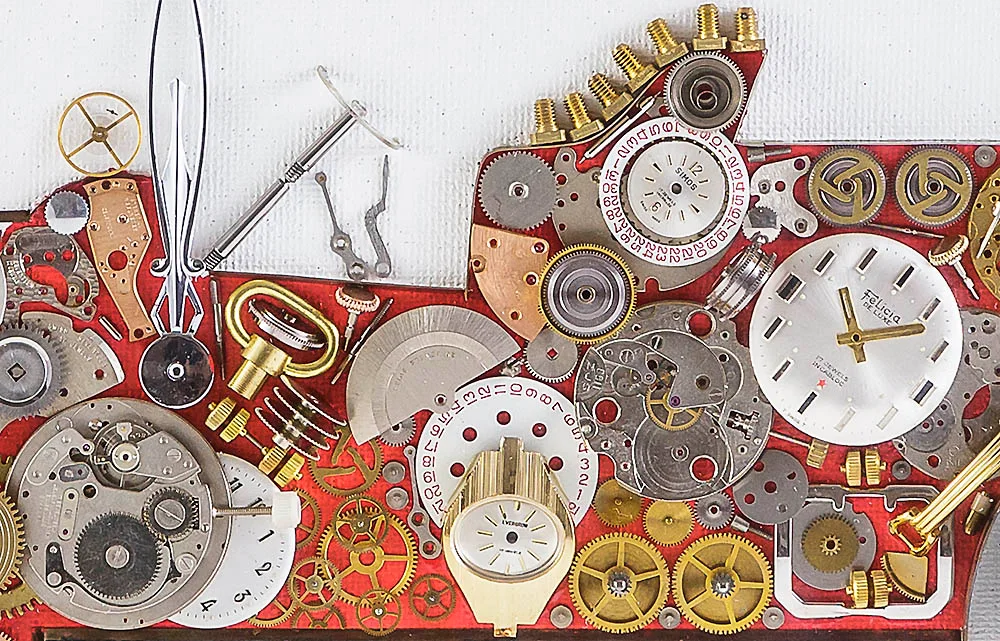
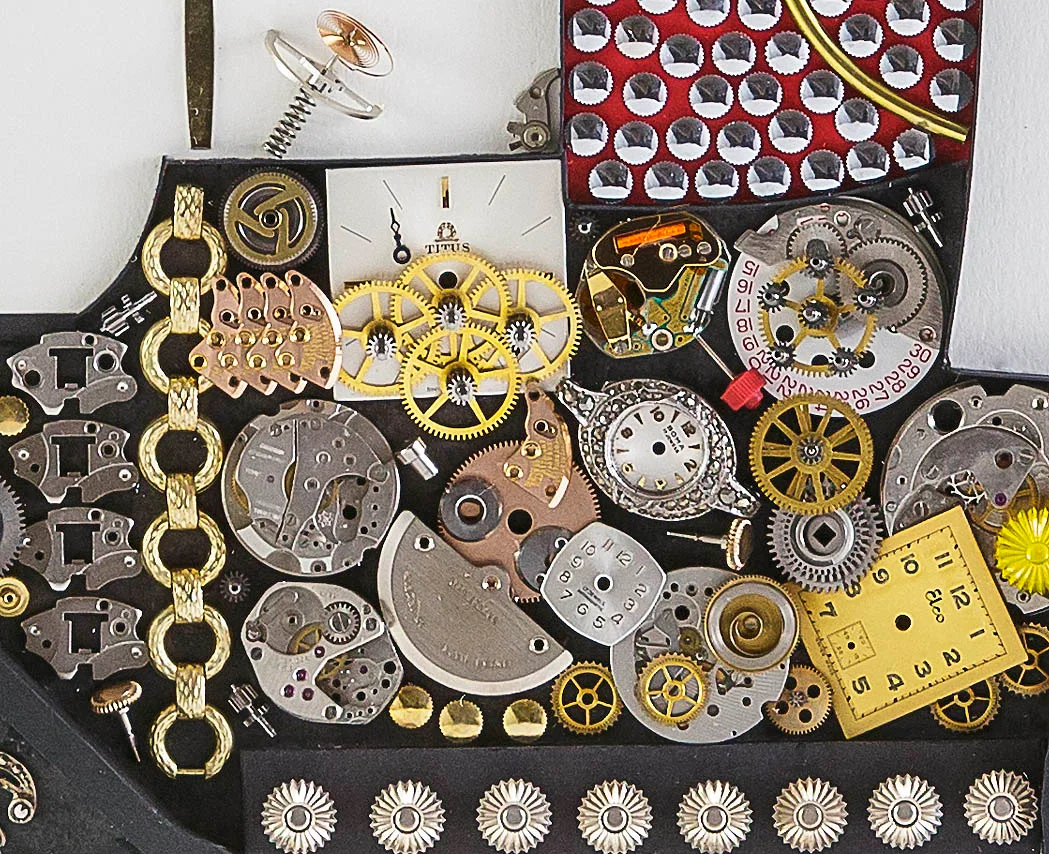
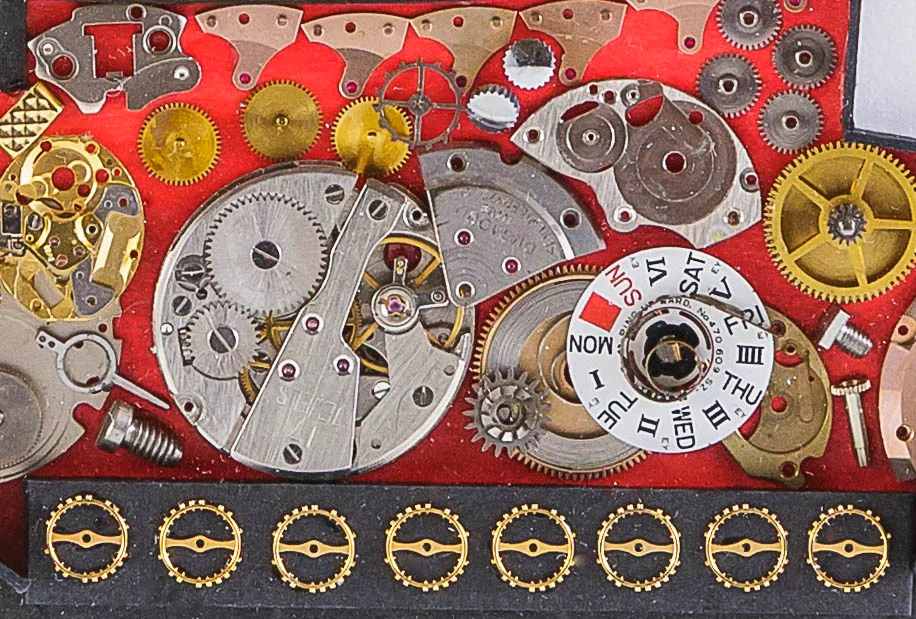
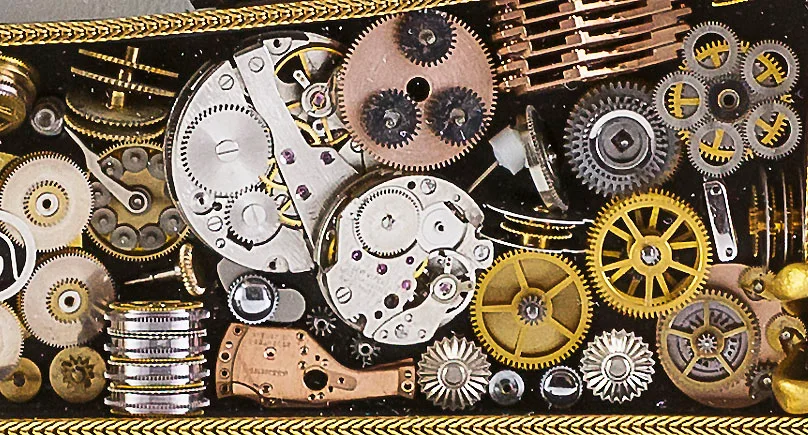
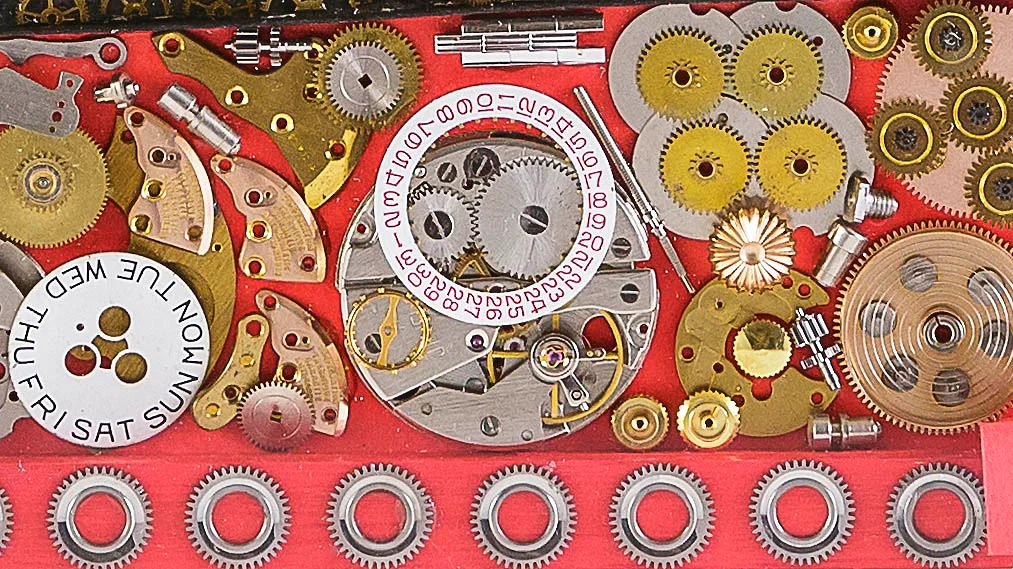
Parts used in the collages include watch dials, clock hands, balance wheels, winding crowns, springs and watch bands.
The parts are affixed to a quality acid free art board by extra strong glue, making the collages safe to transport by post.
George only makes a limited number of collages each year and each is unique and made with meticulous care. His made-to-order collages are also popular with motoring enthusiasts (enquiries welcome).
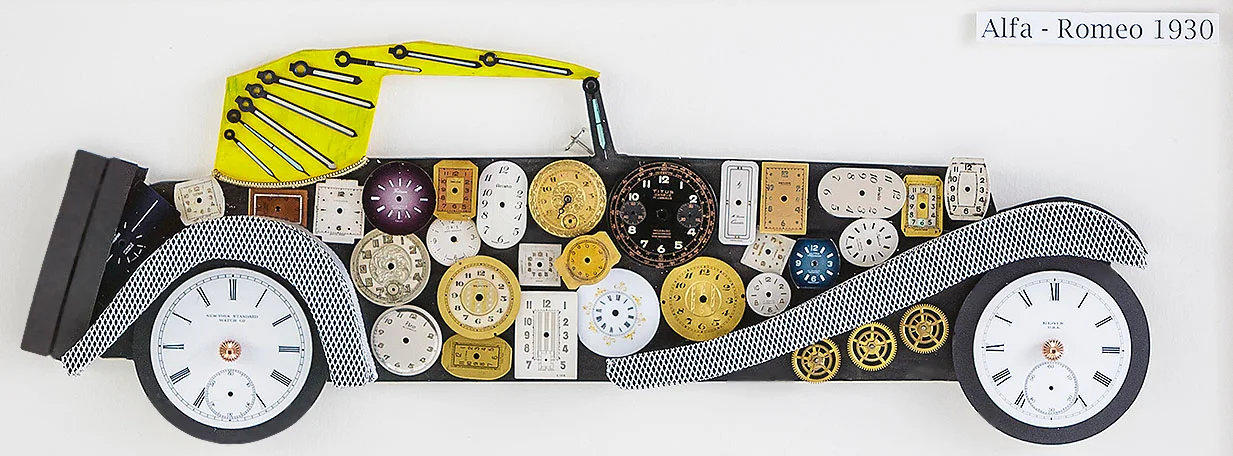
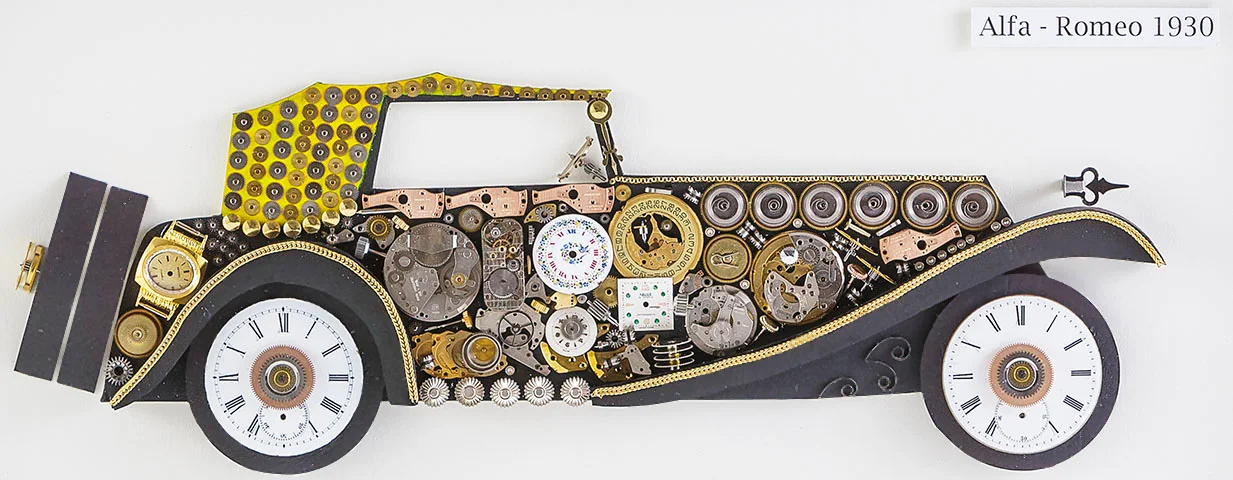
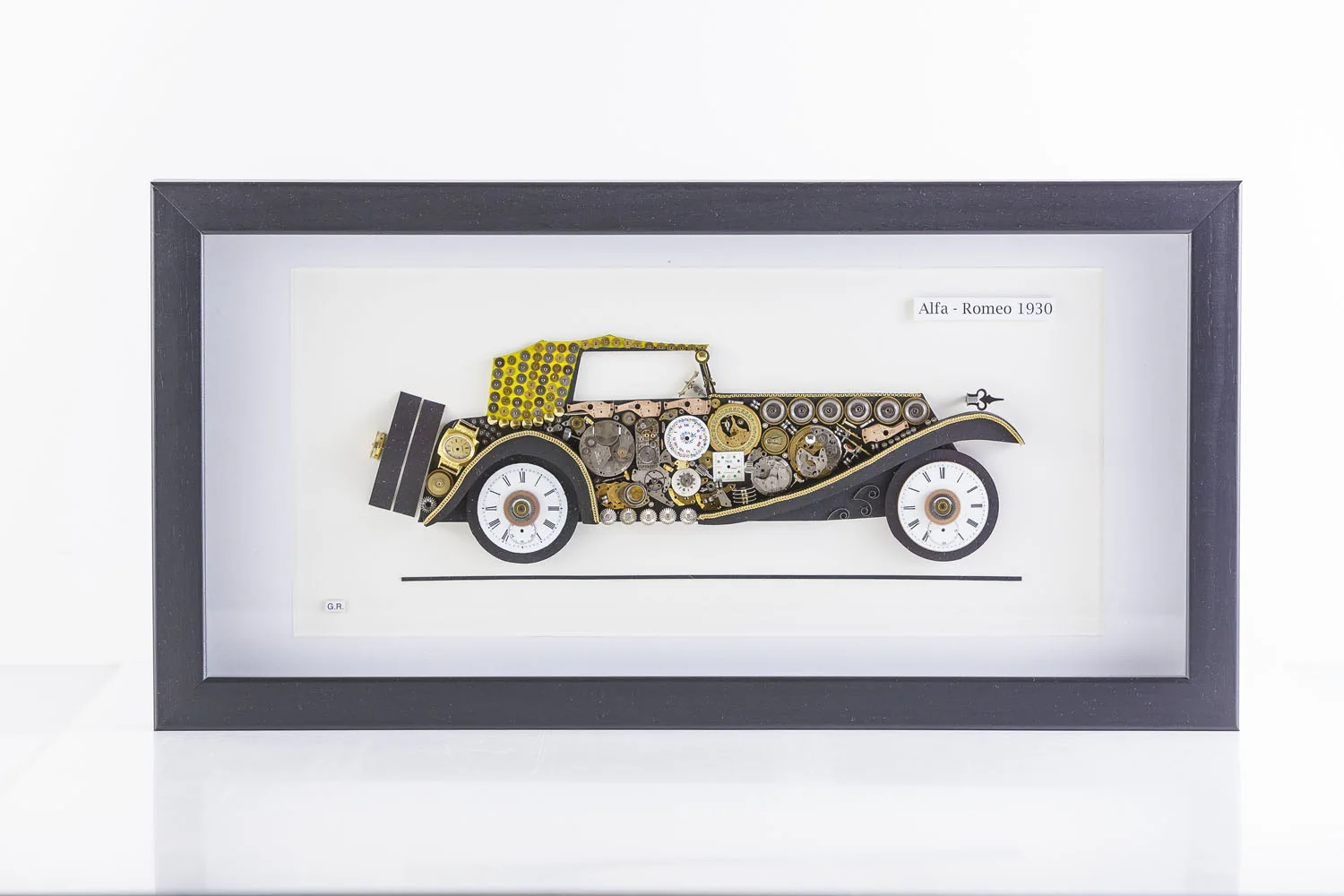
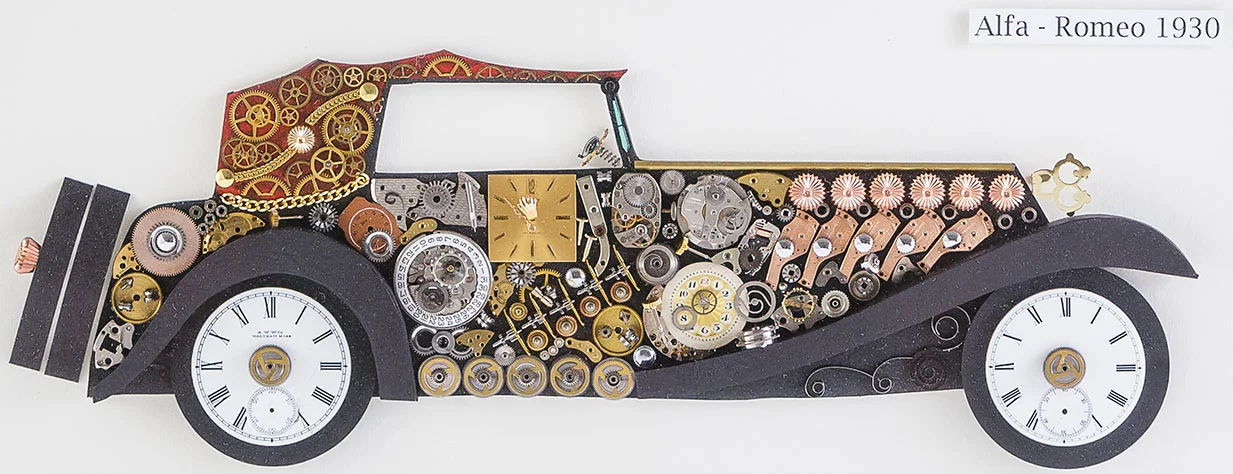
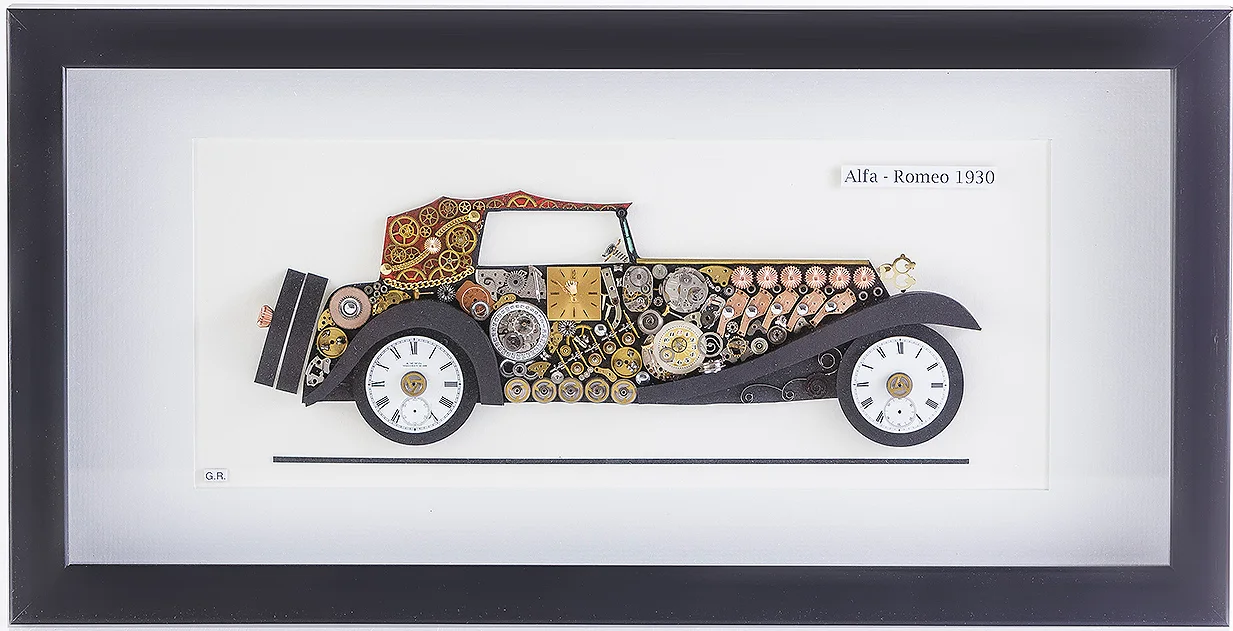
Alfa-Romeo 1930
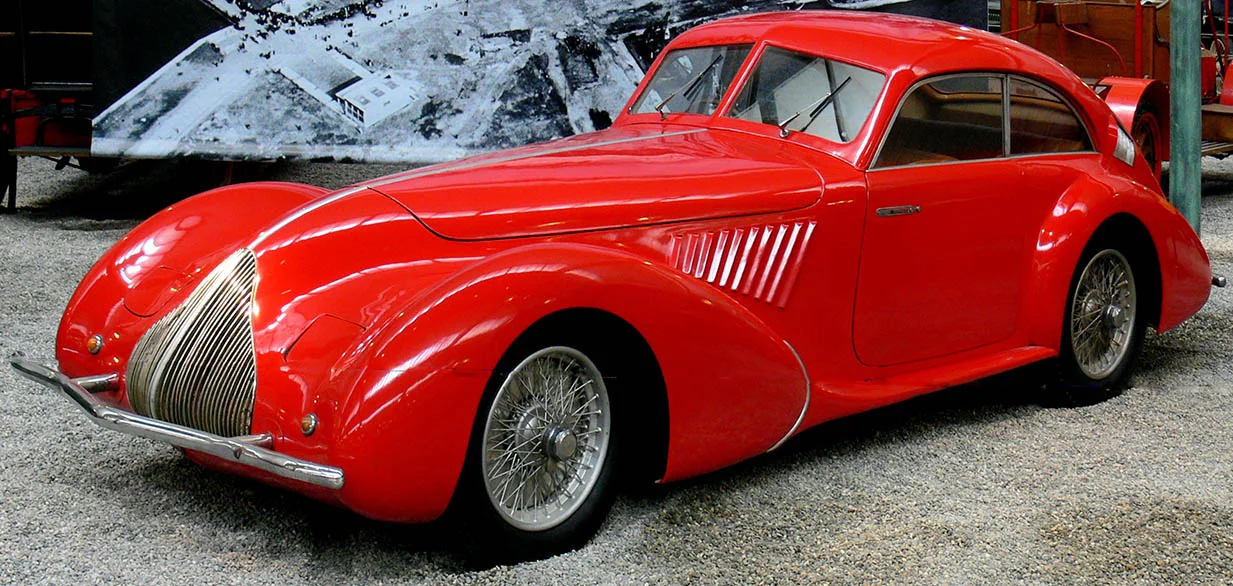
Alfa Romeo introduced its Jano-designed, 1752-cc six-cylinder cars in 1929. Adept on both road and racing circuits, their dual overhead-cam power plant proved reliable and powerful, developing remarkable output from their relatively small displacement. Further benefiting from excellent handling, the car, in top factory racing engine trim, could comfortably exceed 100 mph.
- Collage: Features 20 watch and clock components and 30 wrist- and pocket-watch dials
- Weight: 1.6 kg (3.5 lb)
- Frame Dimensions: 52 x 26 cm (20" x 10")
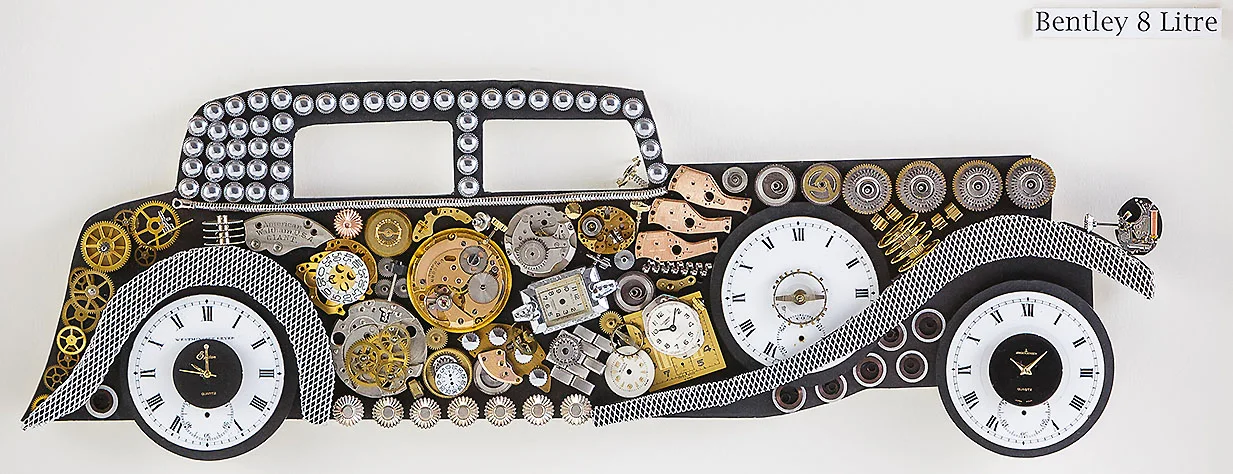
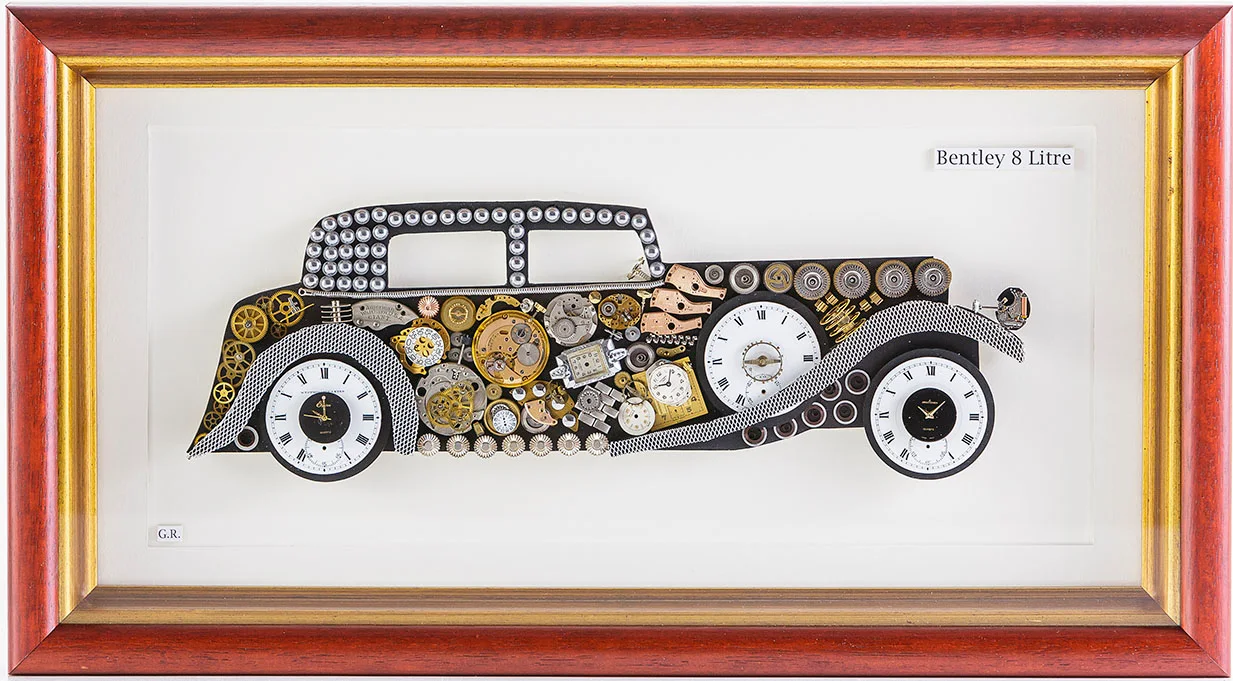
Bentley 8 Litre
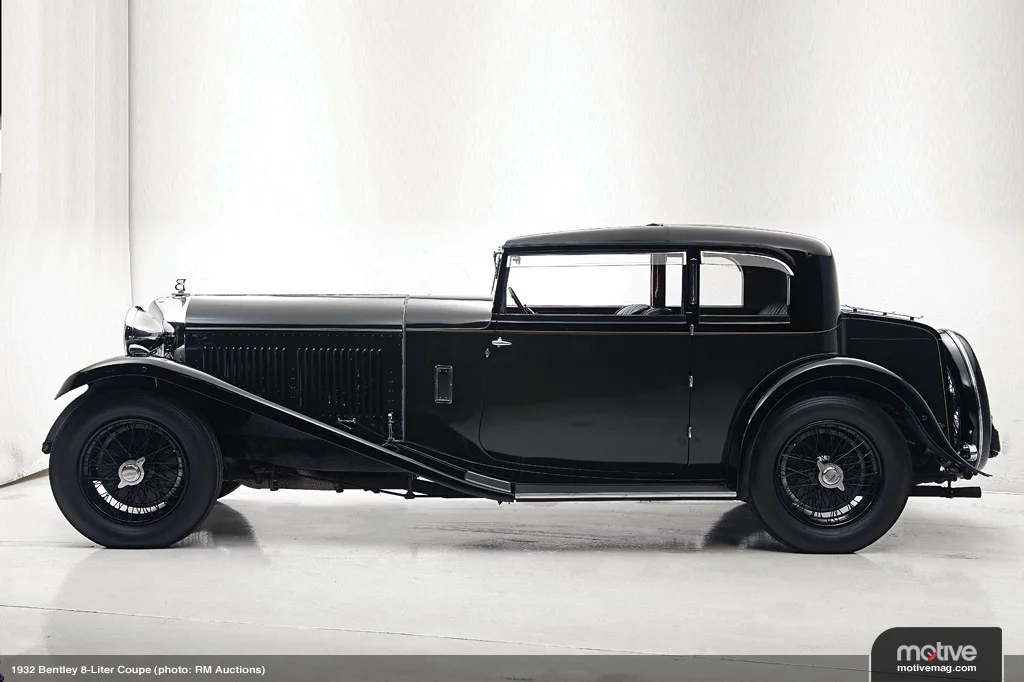
The Bentley 8 Litre was a luxury car based on the largest rolling chassis made by Bentley Motors Limited at Cricklewood, London. Announced 15 September 1930, it was also the last completely new model by Bentley before the company's financial collapse and forced sale to Rolls-Royce Limited; a 4-Litre engine in a shortened chassis was announced on 15 May 1931. Intended to provide the basis for a super-luxury car for very wealthy buyers, the 8 Litre chassis was introduced a year into the Great Depression. Sales of the 8-litre were too slow to tu the company’s finances around and, less than nine months after the 8-litre's introduction, Bentley Motors was placed into receivership.
- Website: Bentley 8-Litre
- Collage: Features over 230 watch part components
- Weight: 1.4 kg (3 lb)
- Frame Dimensions: 44.5 x 24.5 cm (17.5" x 10")
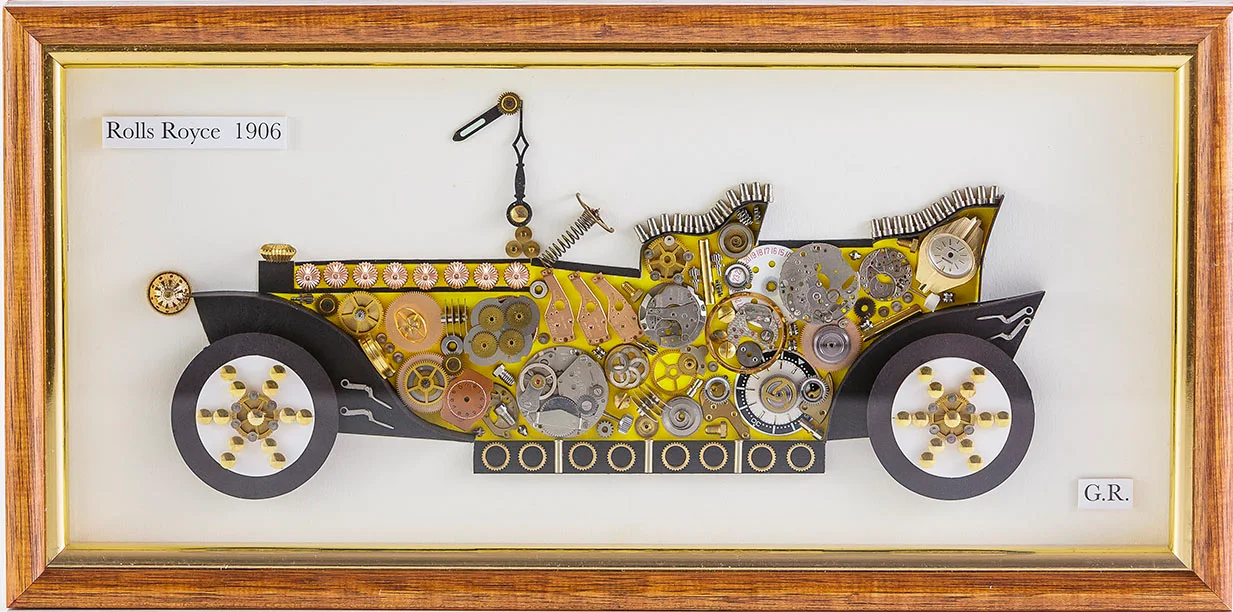
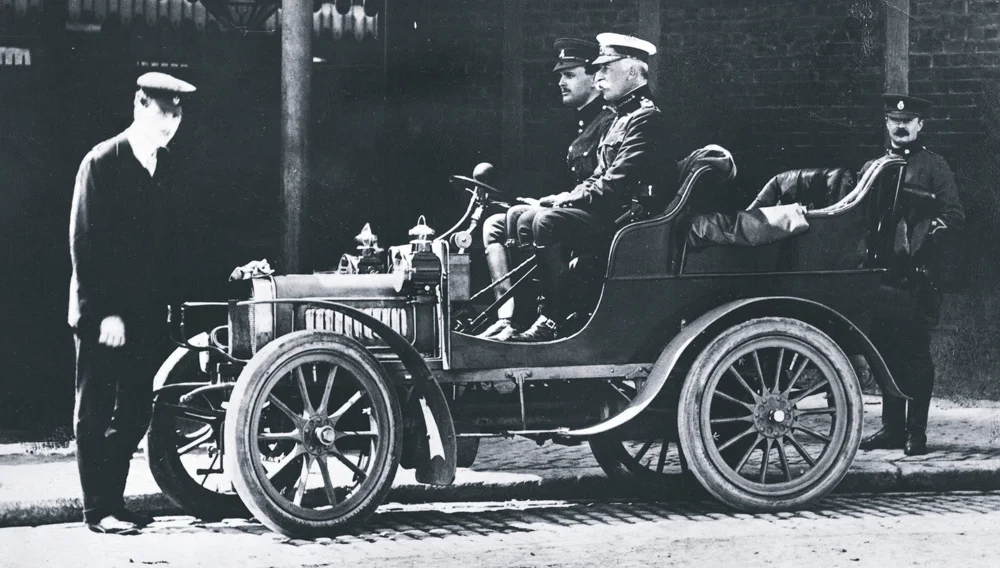
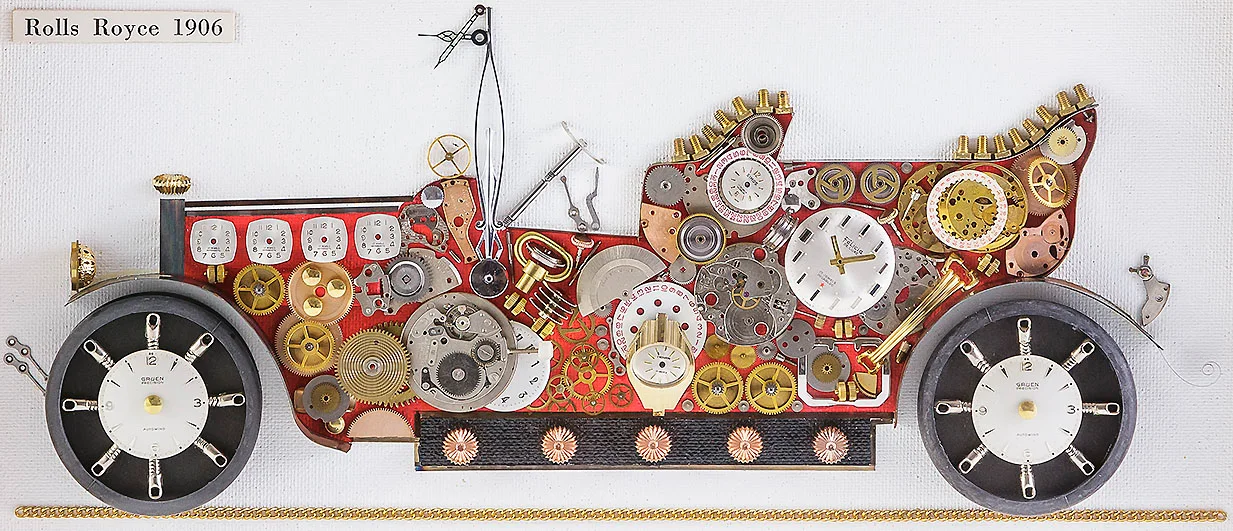
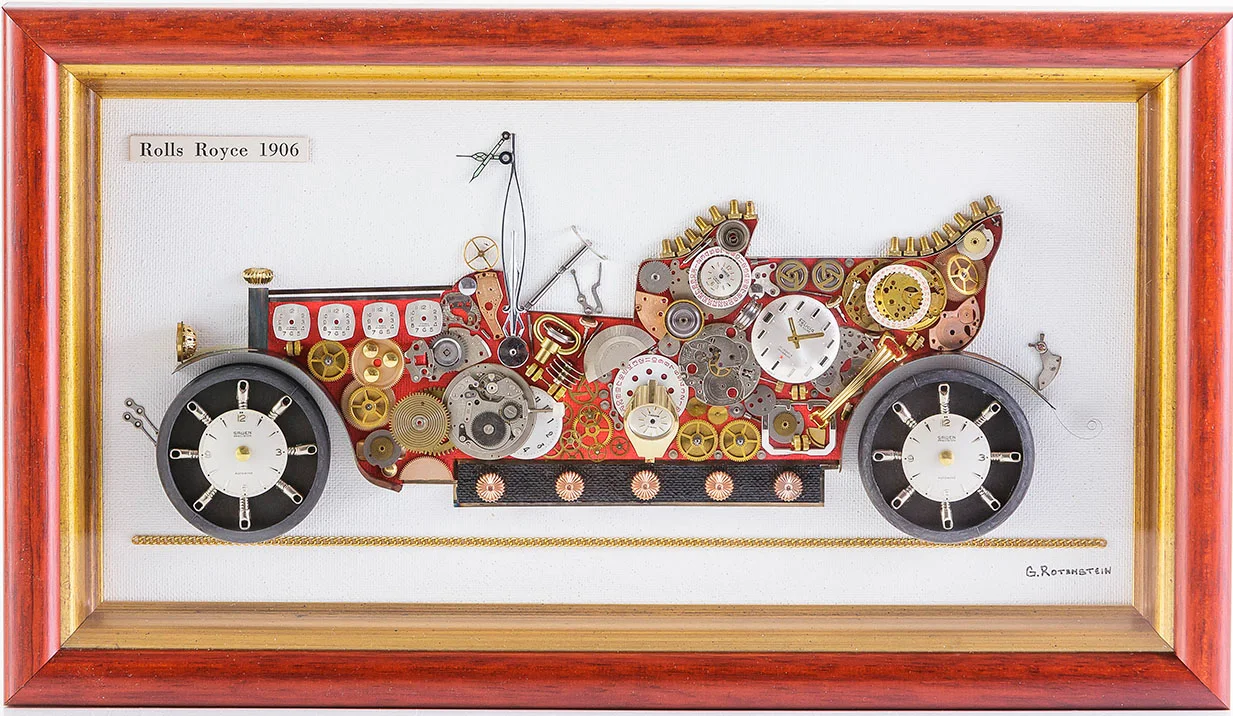
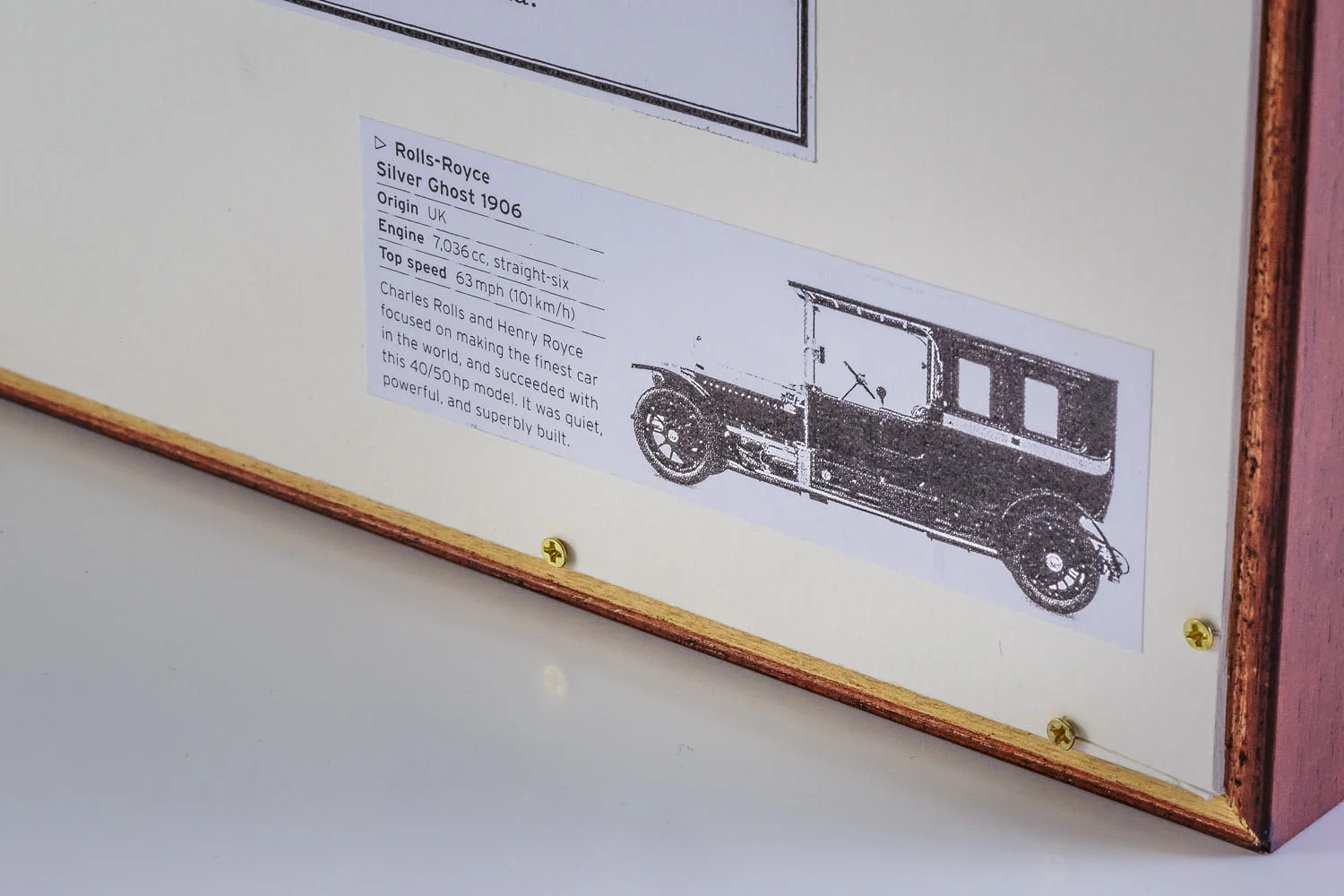
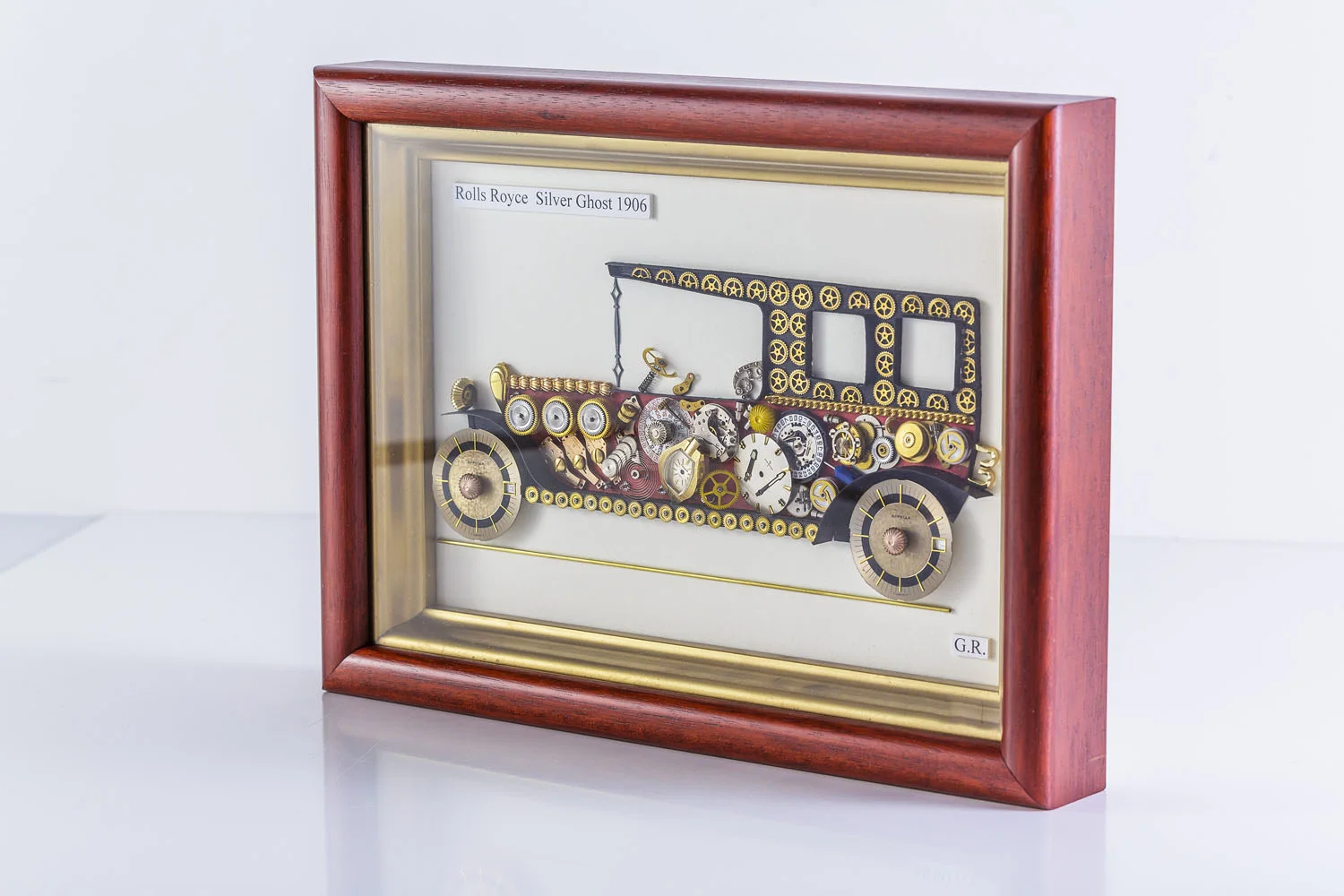
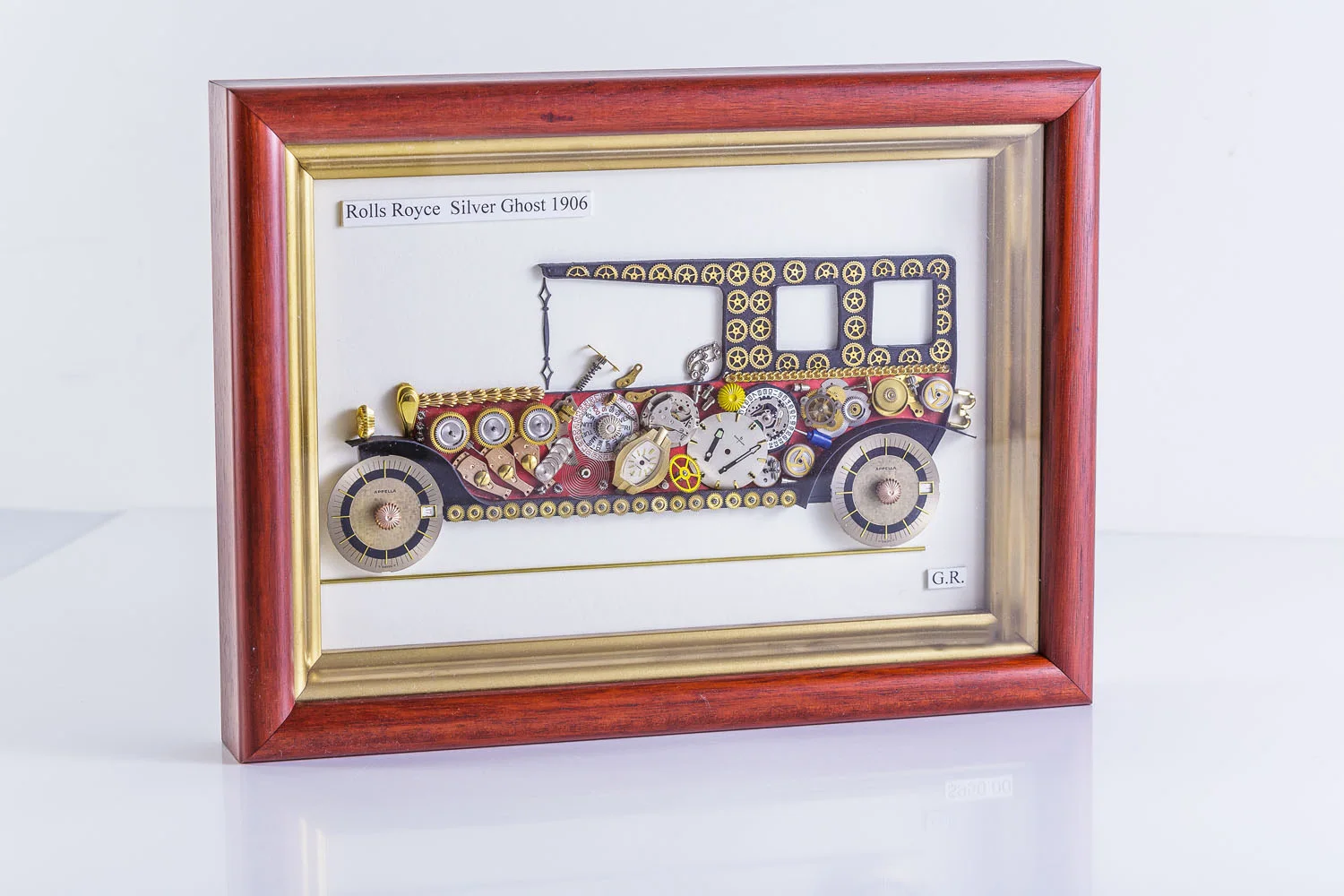
Rolls Royce Silver Ghost 1906
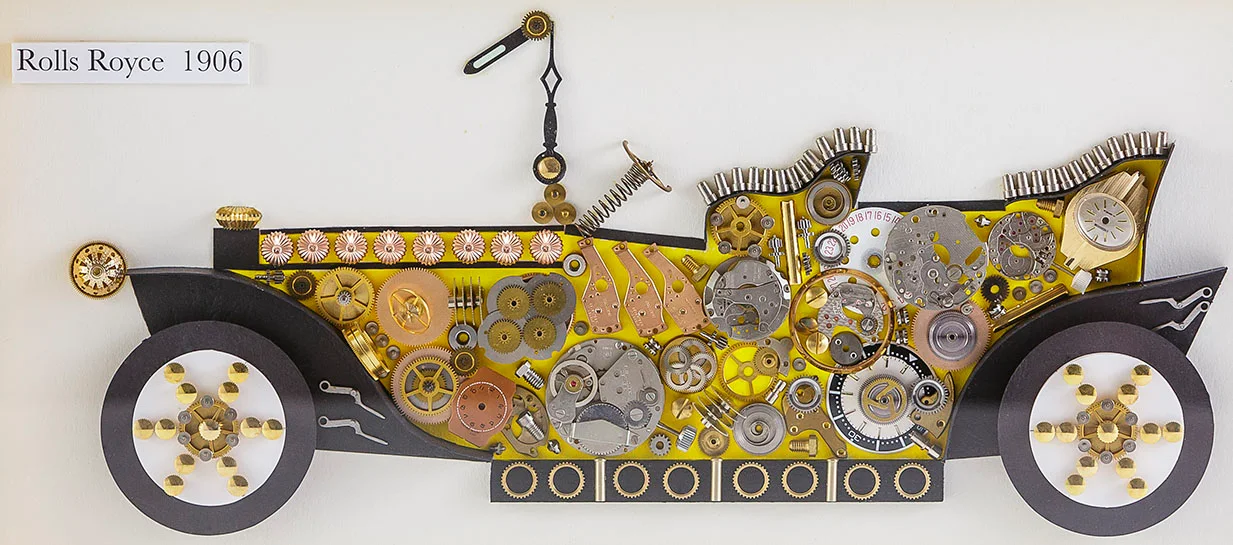
10 hp Rolls-Royce 1904-1906: This was first Rolls-Royce and the first car to have the iconic Greek Parthenon-style radiator. There were 16 of these two cylinder cars produced of which 3 survive.
15 hp Rolls-Royce 1905: This 3-cylinder car was essentially a 10 hp with an additional cylinder added. It was difficult to balance and not as smooth as the others. Six were built of which one survives.
20 hp Rolls-Royce 1905-1906: This was the most successful car prior to the Silver Ghost. It was made in two versions, the Light 20 and the Heavy 20, which was longer and had a 3 speed transmission instead of the 4 speed of the Light 20. The Twenty was similar to the 10 hp, but had four cylinders instead of two. Altogether 40 cars were built but only two survive.
- Collage: Features over 150 watch part components
- Weight: 0.7 kg (1.6 lb)
- Frame Dimensions: 35.5 x 17.5 cm (14" x 7")
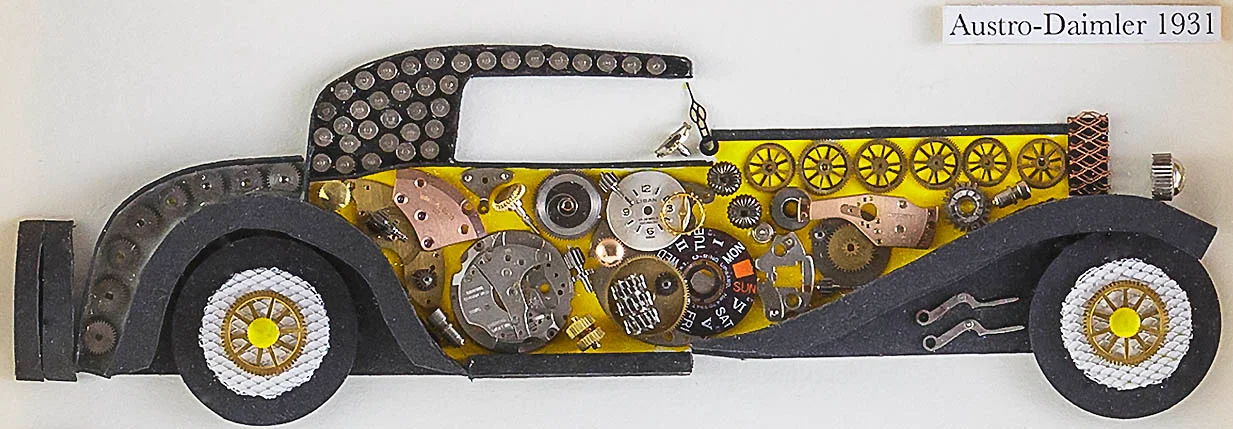
Austro-Daimler 1931
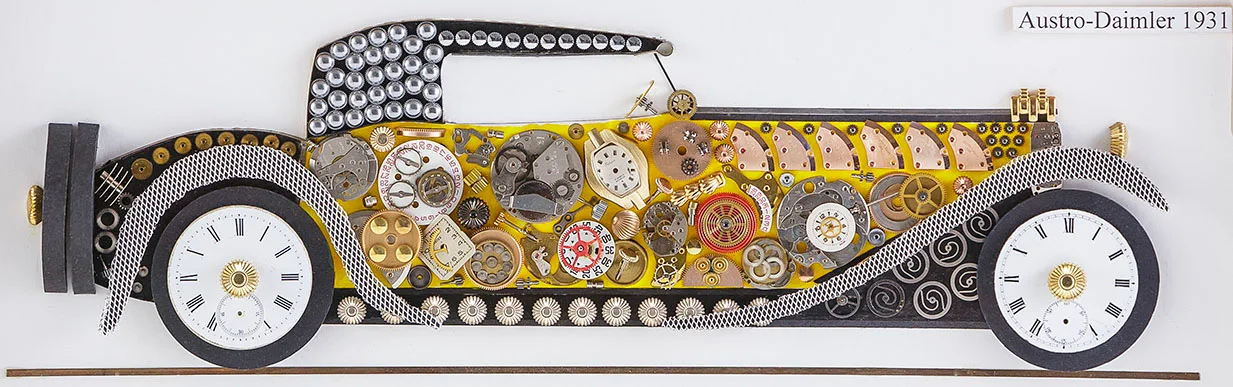
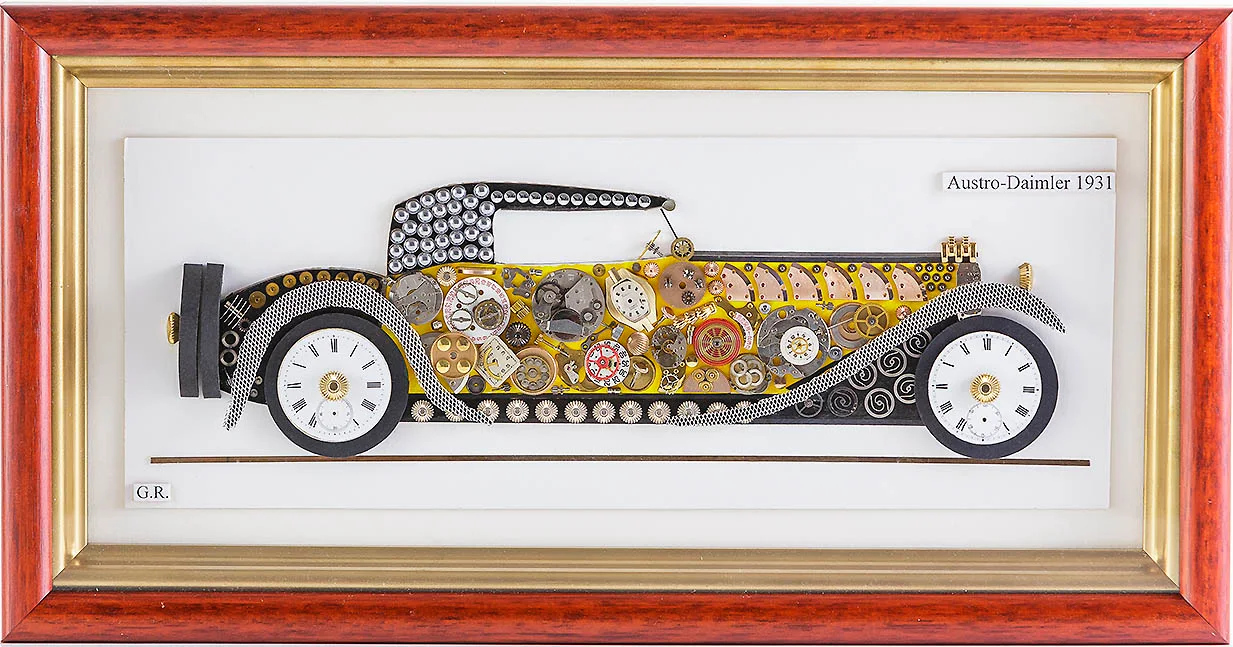
1931 saw Austro-Daimler introduce a 4,624-cc eight-cylinder car, a superb, highly expensive luxury vehicle. The last great car built at the Austrian works was the six-cylinder "Bergmeister", which featured an overhead cam 3,614-cc engine that could develop 120 hp (89 kW) at 3,600 rpm; this car had a top speed of 90 mph (140 km/h). In 1934 the company merged with Steyr Automobile, creating the Steyr-Daimler-Puch conglomerate. However, in this same year, Austro-Daimler was dissolved.
- Collage: Features over 320 watch part components
- Weight: 1.3 kg (2.8 lb)
- Frame Dimensions: 45 x 23 cm (17.5" x 9")
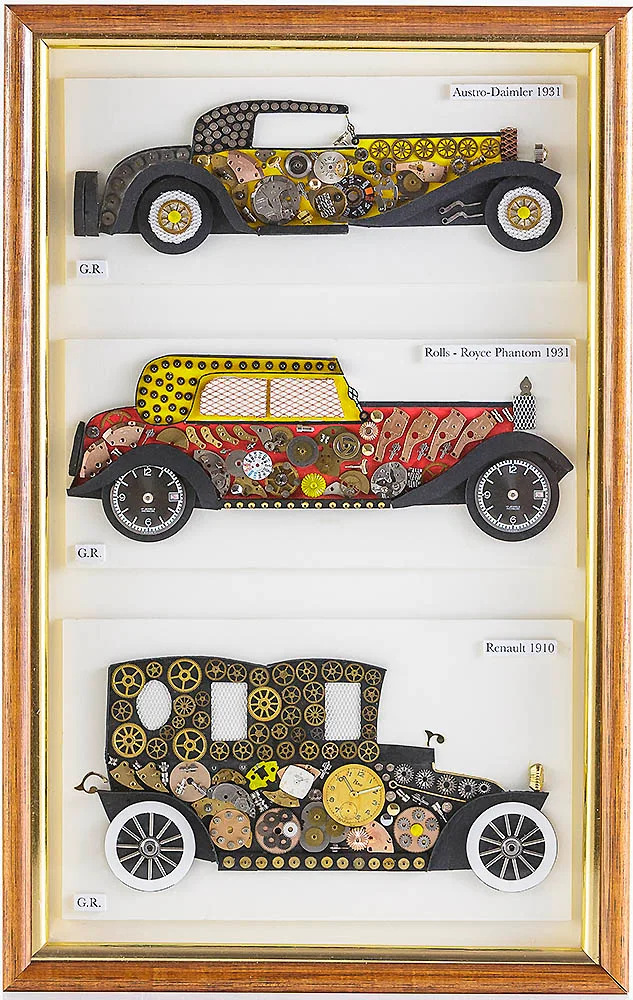
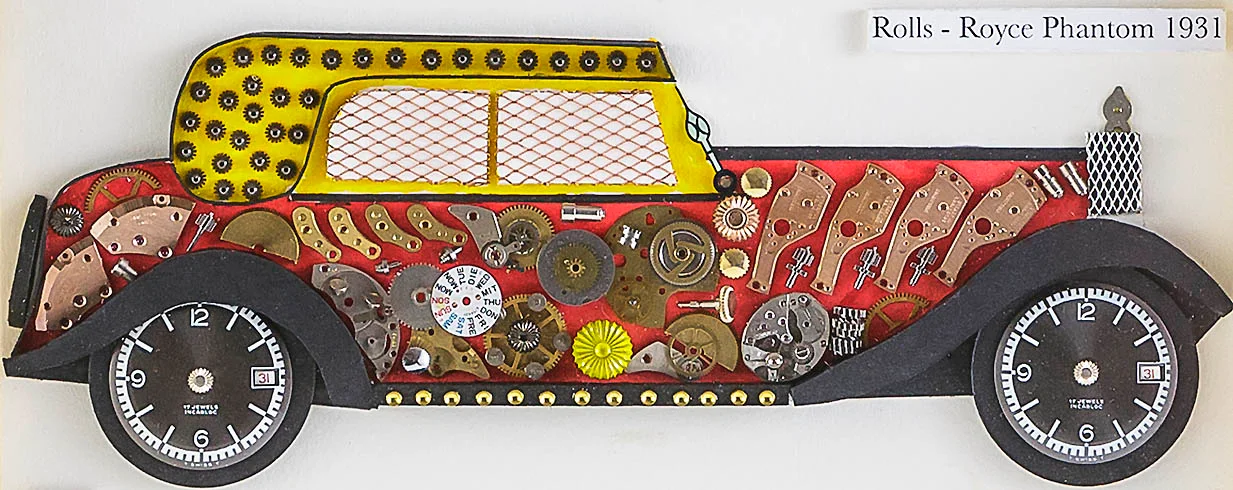
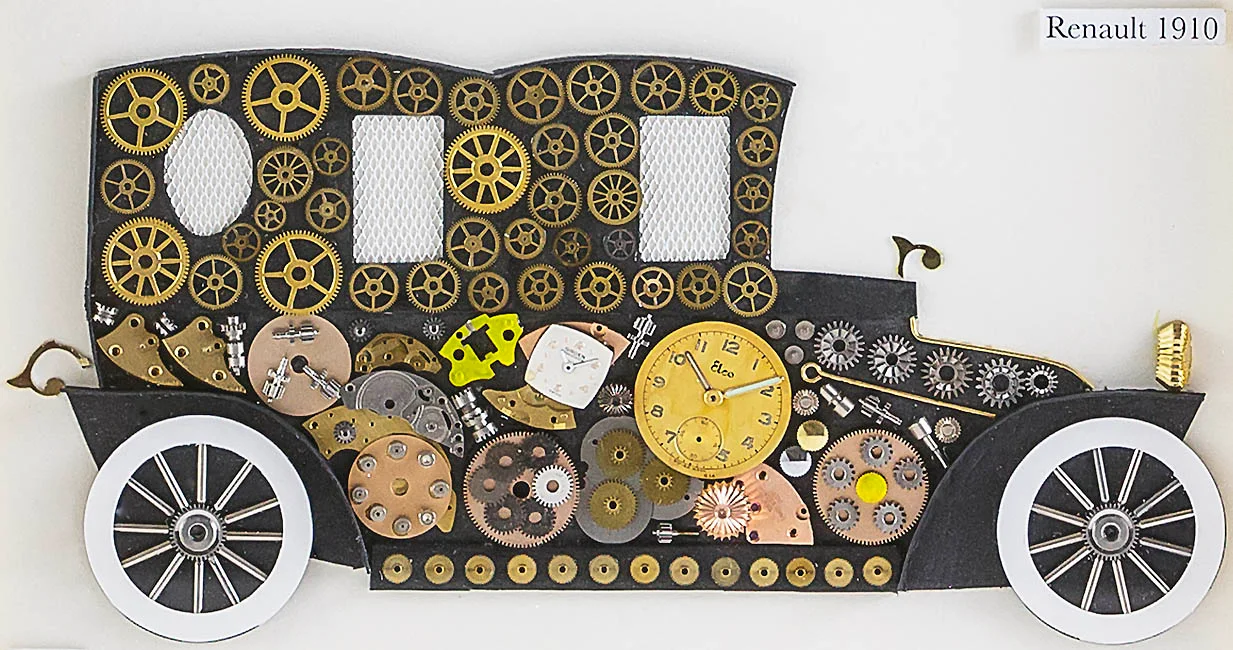
Triple Collage: Austro-Daimler 1931, Rolls Royce Phantom 1931, Renault 1910
Austro-Daimler 1931: 1931 saw Austro-Daimler introduce a 4,624-cc eight-cylinder car, a superb, highly expensive luxury vehicle. The last great car built at the Austrian works was the six-cylinder "Bergmeister", which featured an overhead cam 3,614-cc engine that could develop 120 hp (89 kW) at 3,600 rpm; this car had a top speed of 90 mph (140 km/h). In 1934 the company merged with Steyr Automobile, creating the Steyr-Daimler-Puch conglomerate. However, in this same year, Austro-Daimler was dissolved.
Rolls-Royce Phantom 1931: 1931 marked a watershed year for Rolls-Royce. Sales of Springfield Phantoms fell so precipitously that production of Phantoms at the factory in Springfield, Massachusetts ceased. Consequently, the chassis for the Phantom II on display was manufactured in England and exported to the United States where it was fitted with a Brewster Savoy Town Car body.
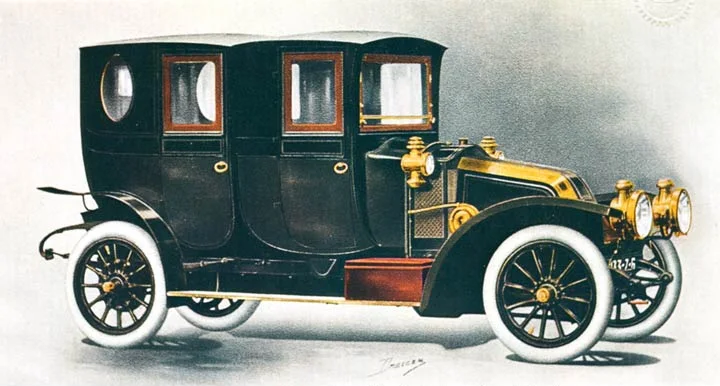
Renault 1910: In 1908, Renault unveiled an all-new AX chassis, fitted with a two-cylinder engine. As the most affordable model in the company’s model line, it was an instant favorite among taxi drivers in both Paris and London. By 1910, the AX’s engine was improved with an increase in output to 12 horsepower alongside the introduction of the more affordable AG.
- Collage: Features over 380 watch part components
- Weight: 1.15 kg (2.5 lb)
- Frame Dimensions: 24.5 x 38.5 cm (9.5" x 15")
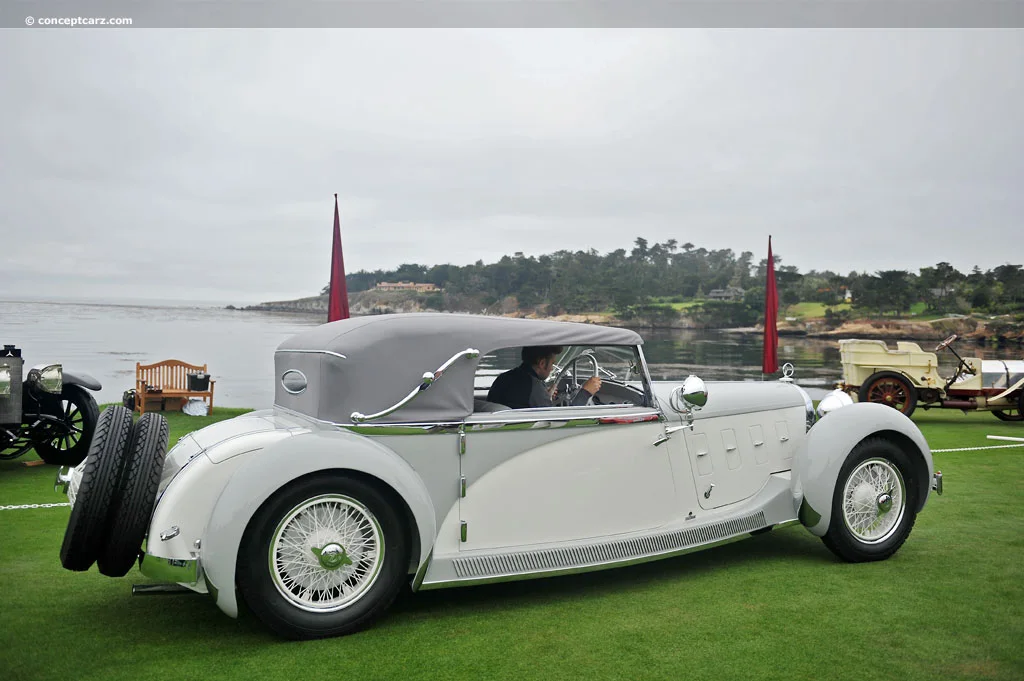
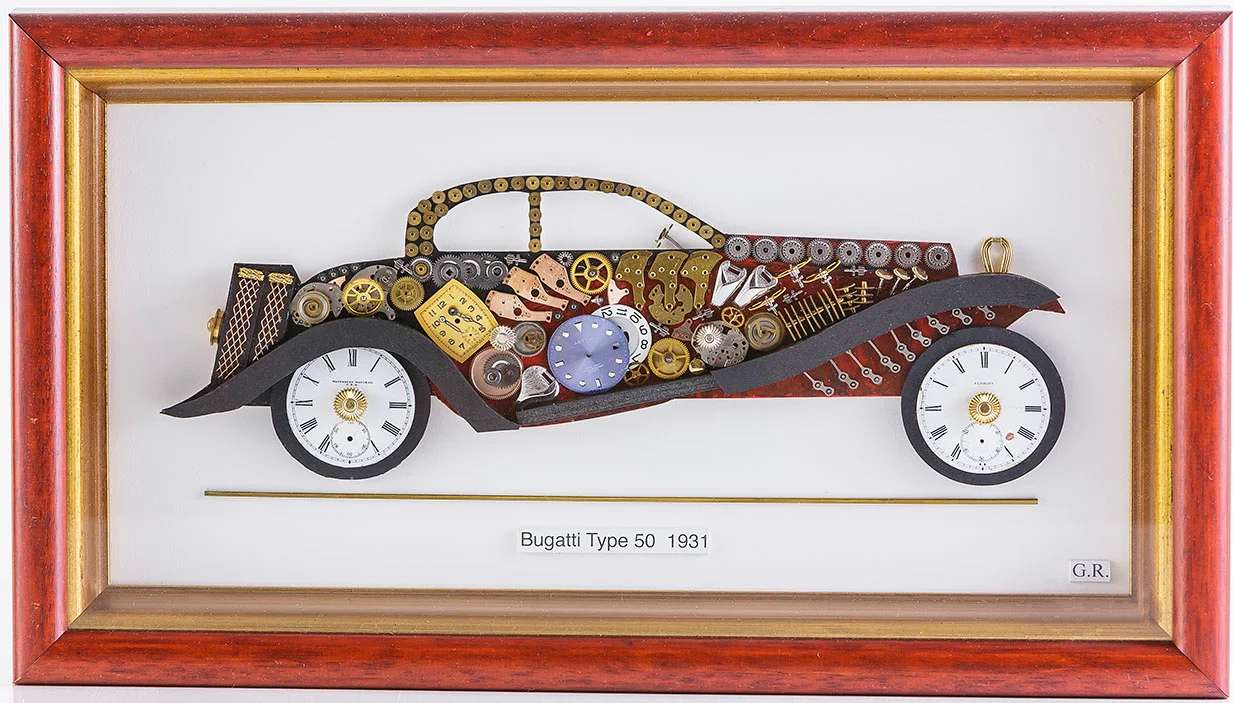
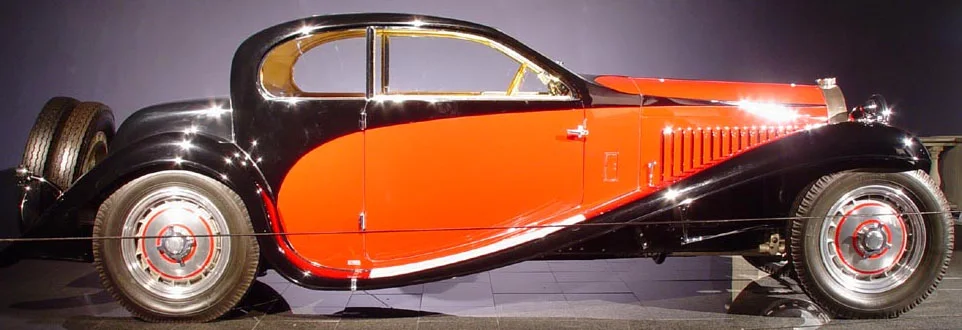
Bugatti Type 50 Coupé 1931
The Type 50 T (Touring) version was introduced to the large public in 1930 and featured a longer wheelbase as compared to its initial T50 model.
In fact, the 50 T shared its chassis construction with the Type 46 model while equipped with a newly-developed 5.0L engine delivering up to 200 hp (less than the short-version Type 50). Also, the new Type 50 T was available with an optional 4-door saloon coachwork. Both Type 50 and Type 50 T models were produced in 65 units from 1930 to 1934, while also providing the base for the Type 50 Grand Sport prototype in 1930 (powered by a 24 Hours of Le Mans-designed 4.9L 8-inline unit).
- Collage: Features over 180 watch part components
- Weight: 1.225 kg (1.7 lb)
- Frame Dimensions: 40 x 22.5 cm (16" x 9")
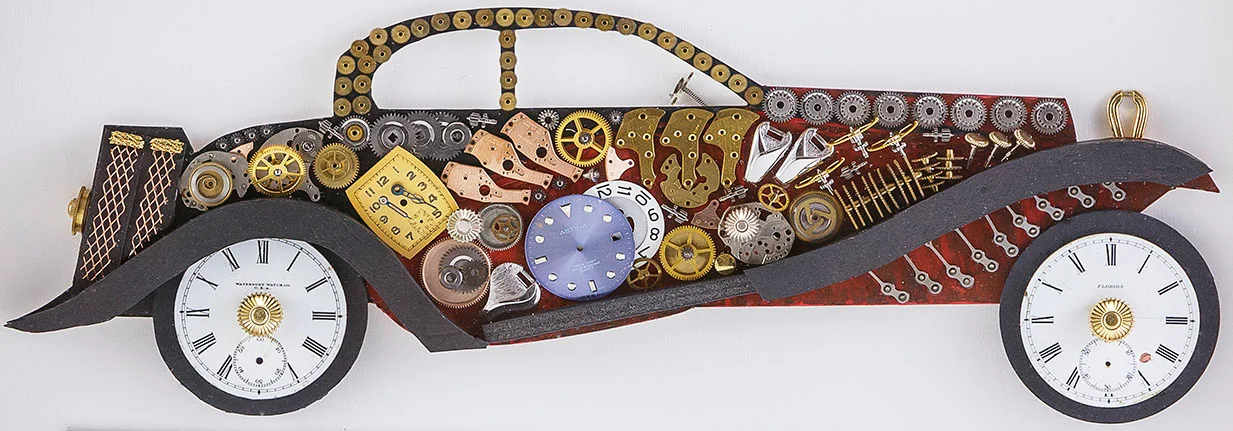
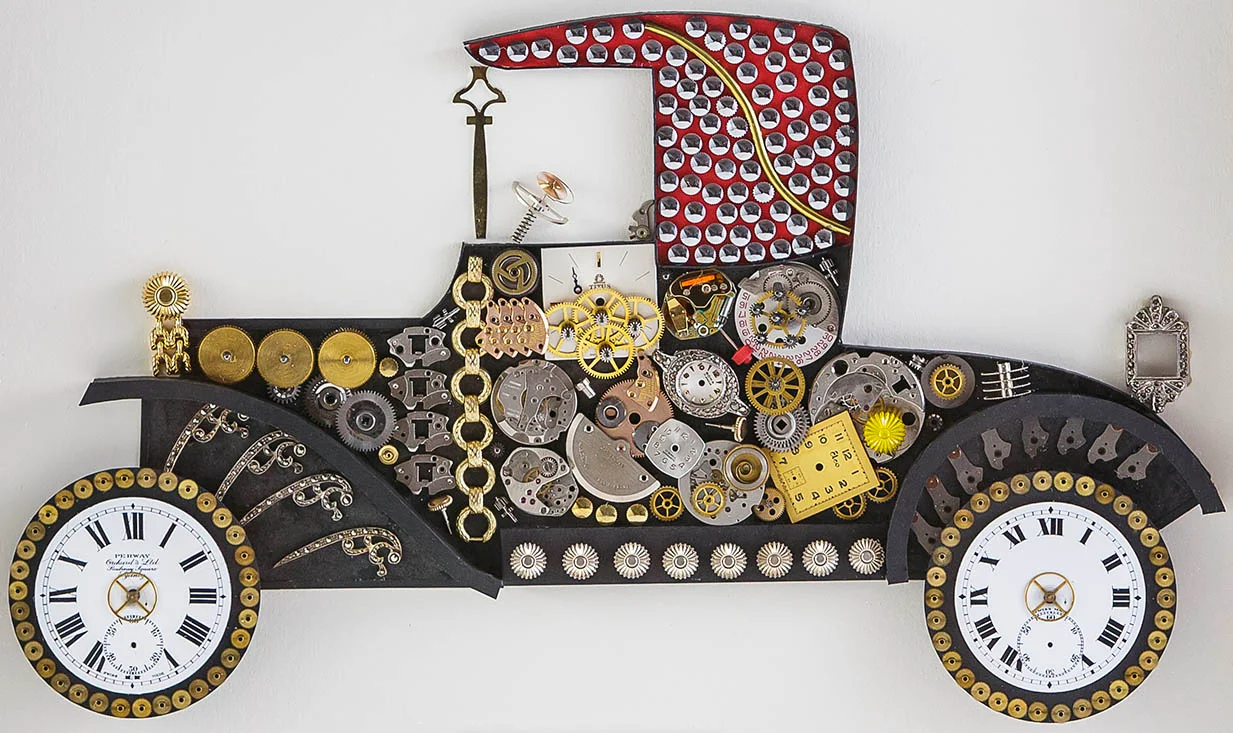
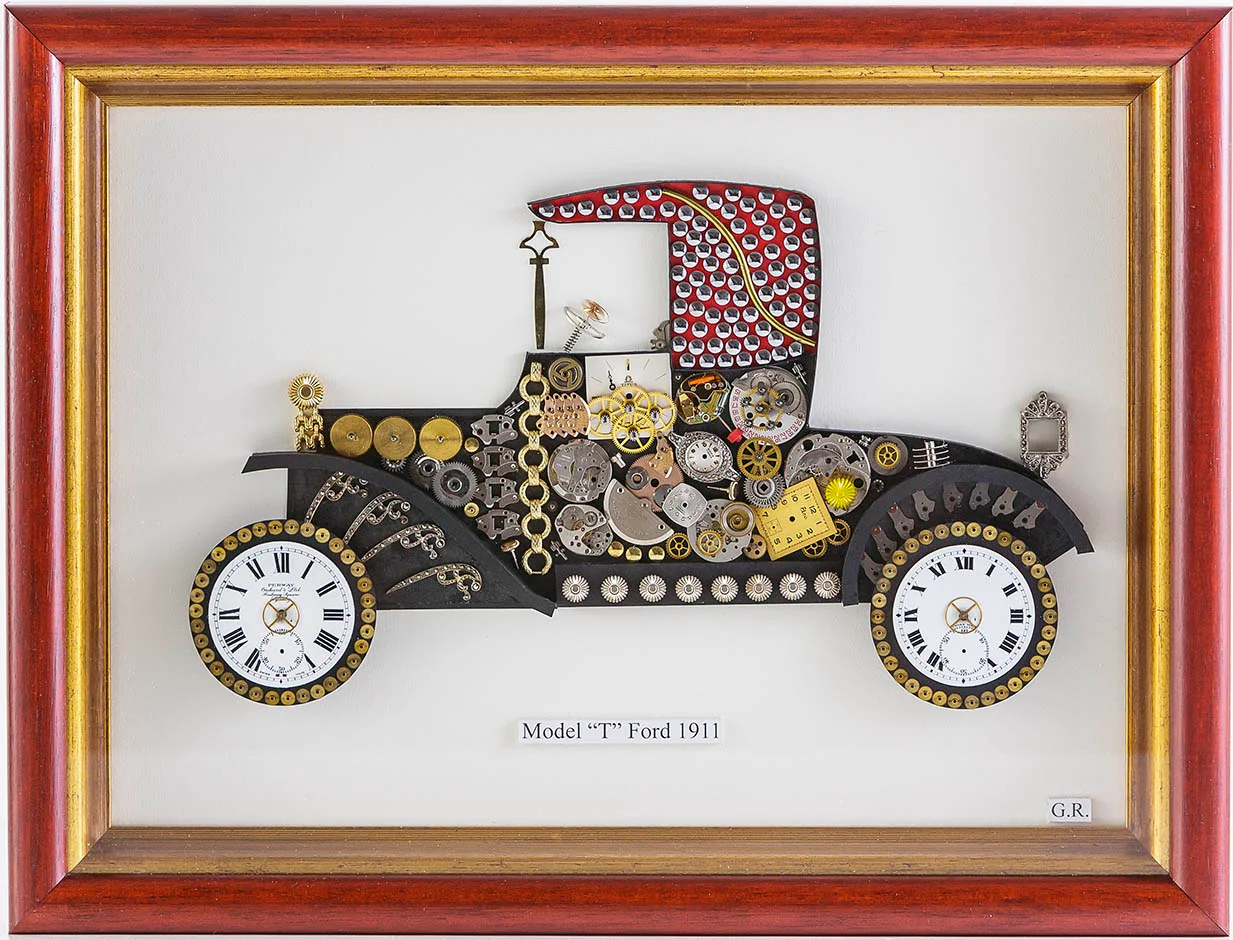
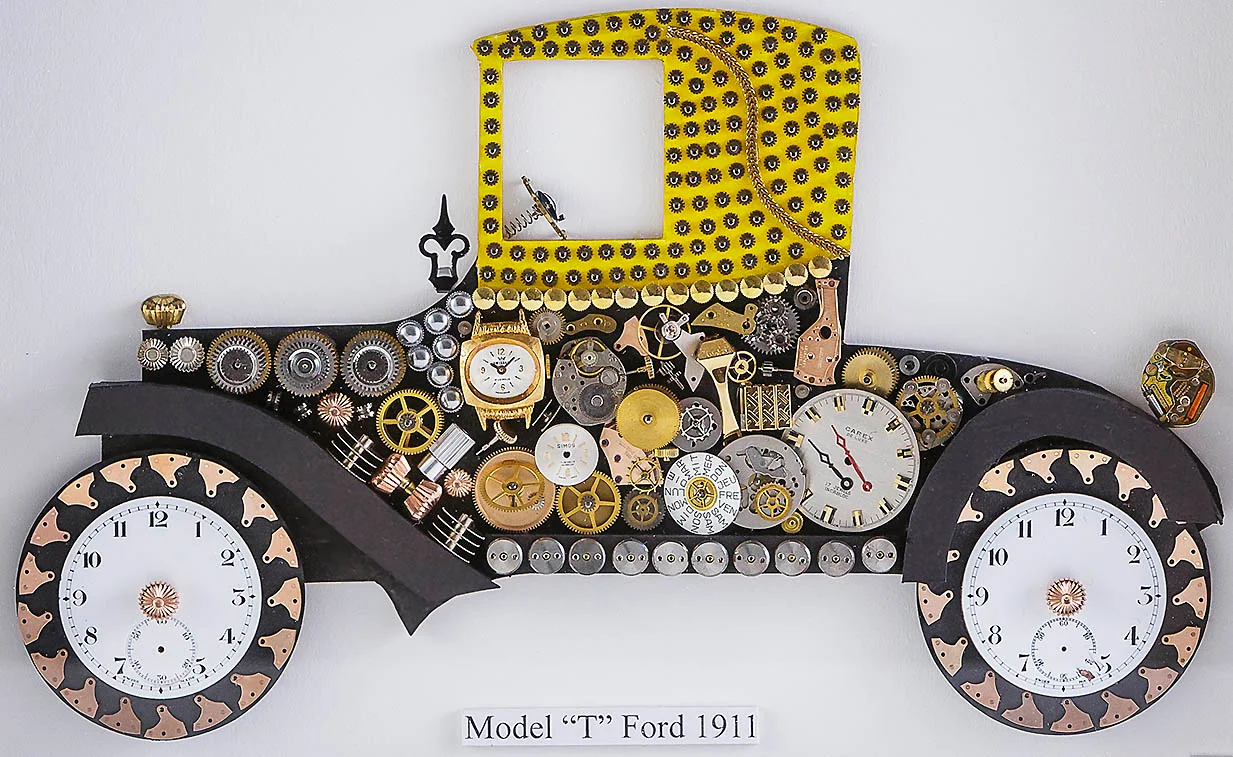
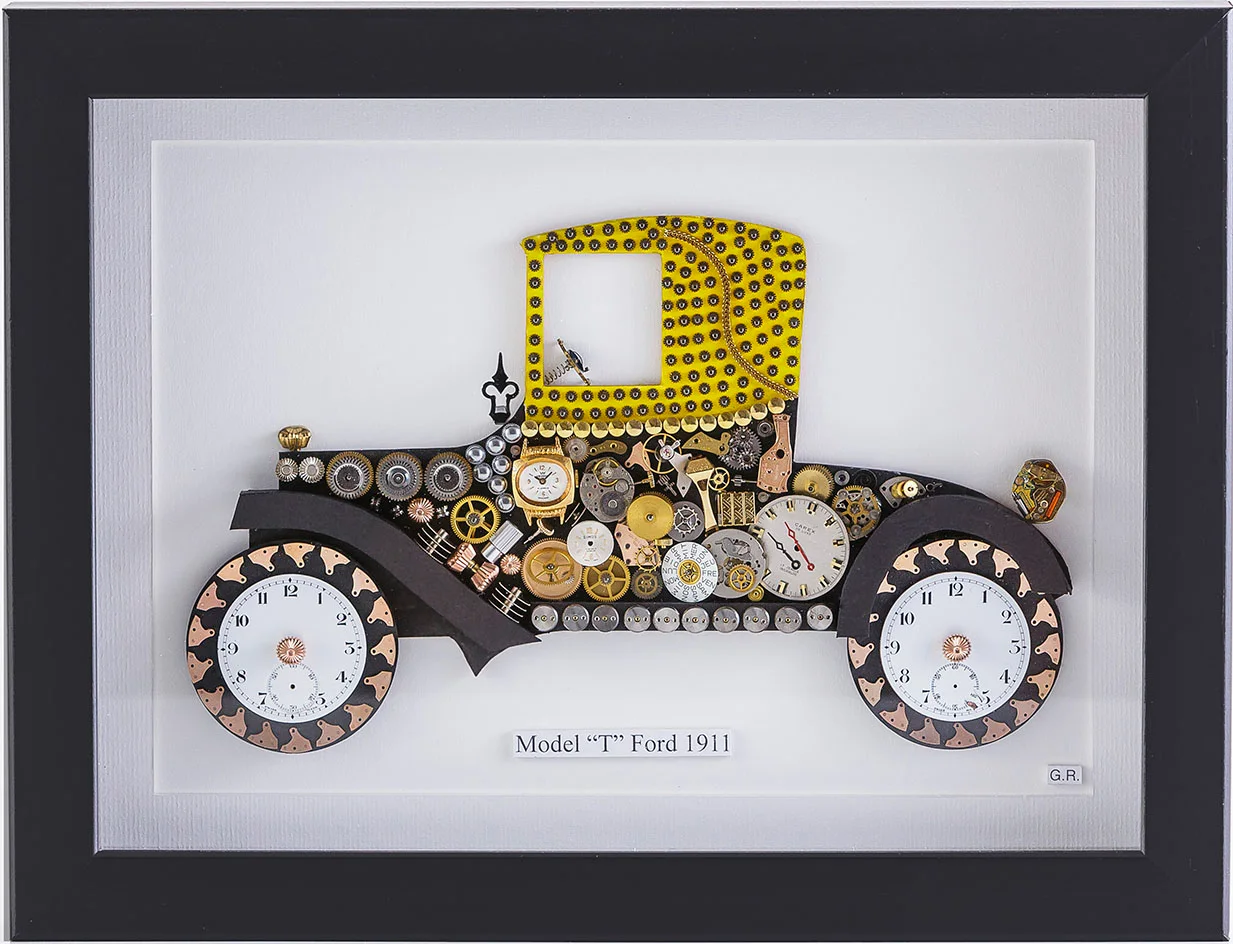
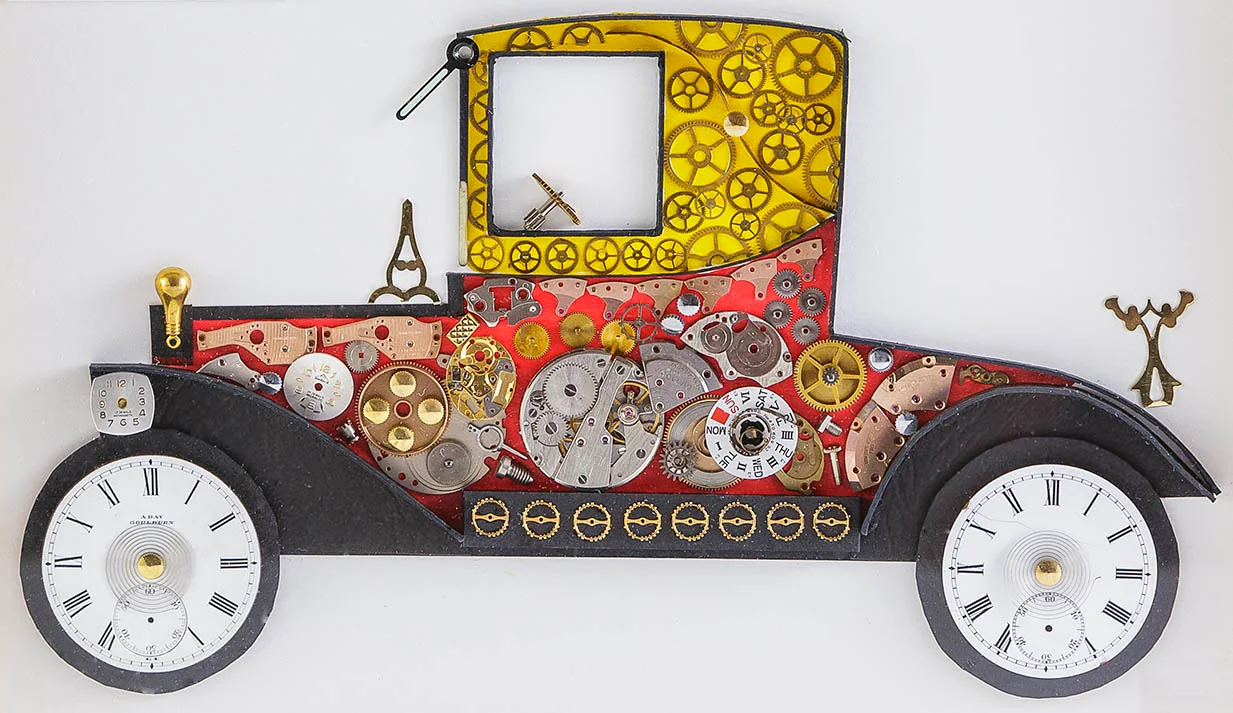
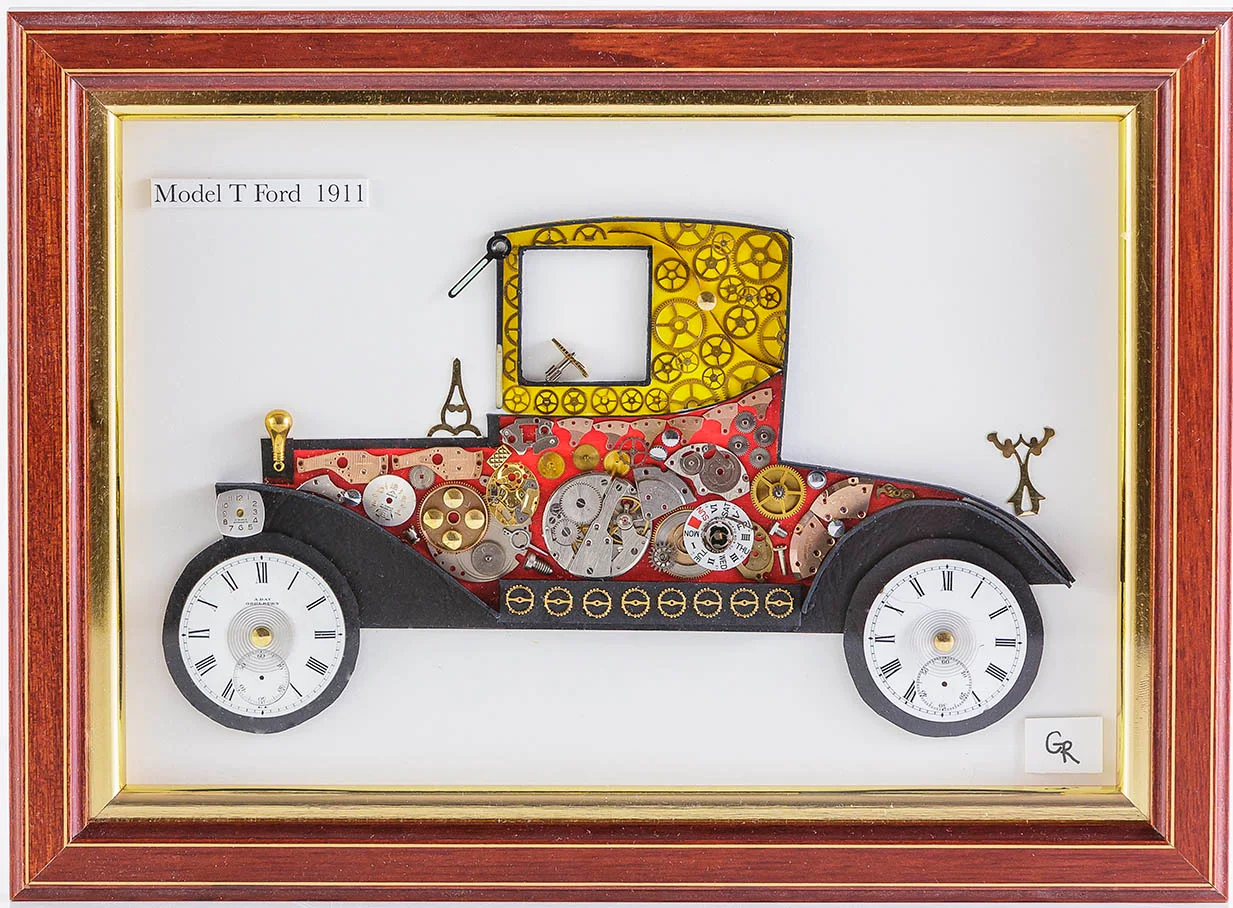
Ford Model T 1911
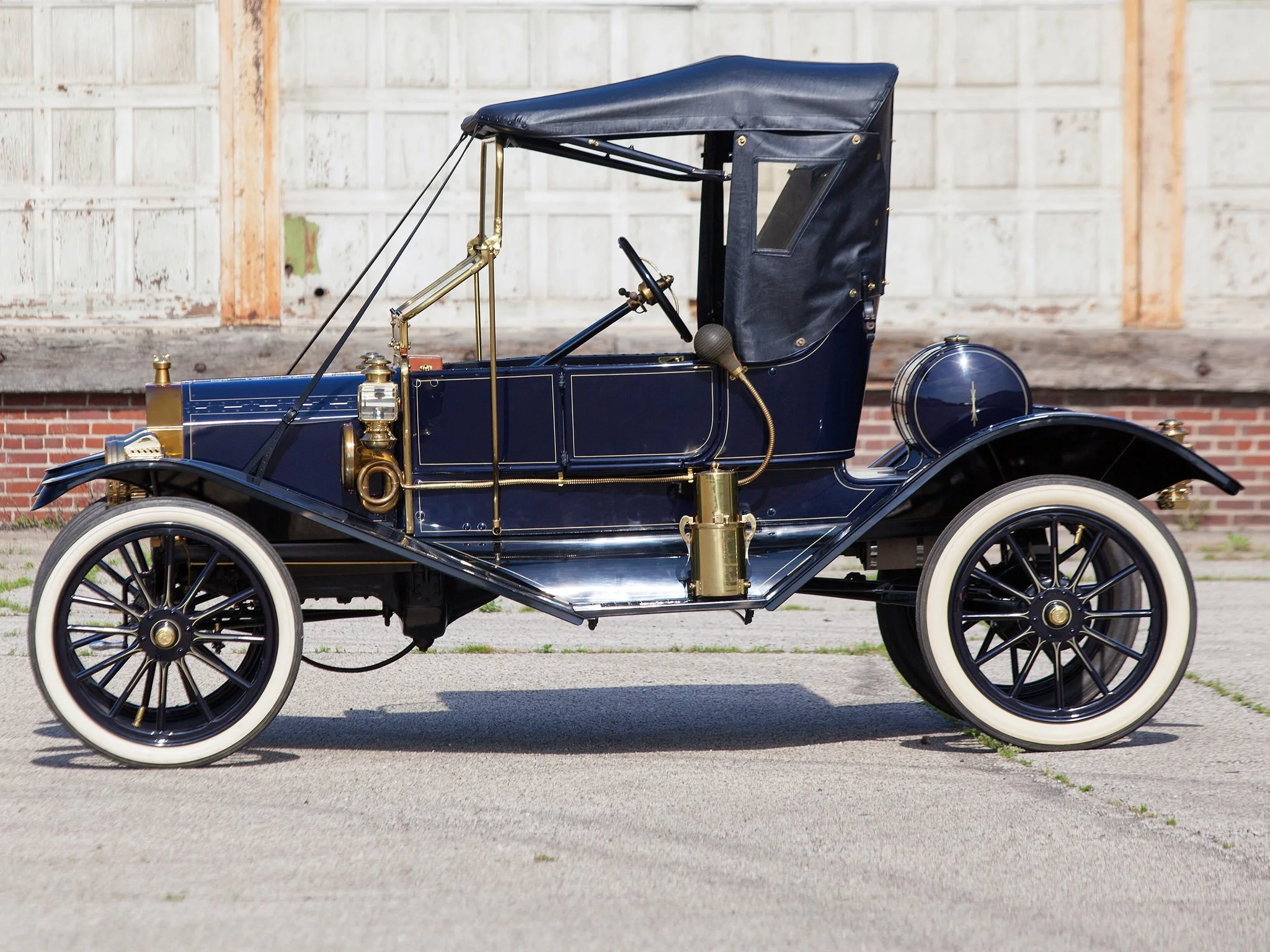
The Ford Model T (colloquially known as the Tin Lizzie, Tin Lizzy, T‑Model Ford, Model T, or T) is an automobile that was produced by Henry Ford's Ford Motor Company from October 1, 1908, to May 26, 1927. It is generally regarded as the first affordable automobile, the car that opened travel to the common middle-class American; some of this was because of Ford's efficient fabrication, including assembly line production instead of individual hand crafting.
The Ford Model T was named the most influential car of the 20th century in the 1999 Car of the Century competition, ahead of the BMC Mini, Citroën DS, and Volkswagen Type 1, and still makes top ten list of most sold cars (ranked number 8) as of 2012.
- Collage: Features over 280 watch part components
- Weight: 1.5 kg (3.3 lb)
- Frame Dimensions: 37.5 x 28.5 cm (14.5" x 11")
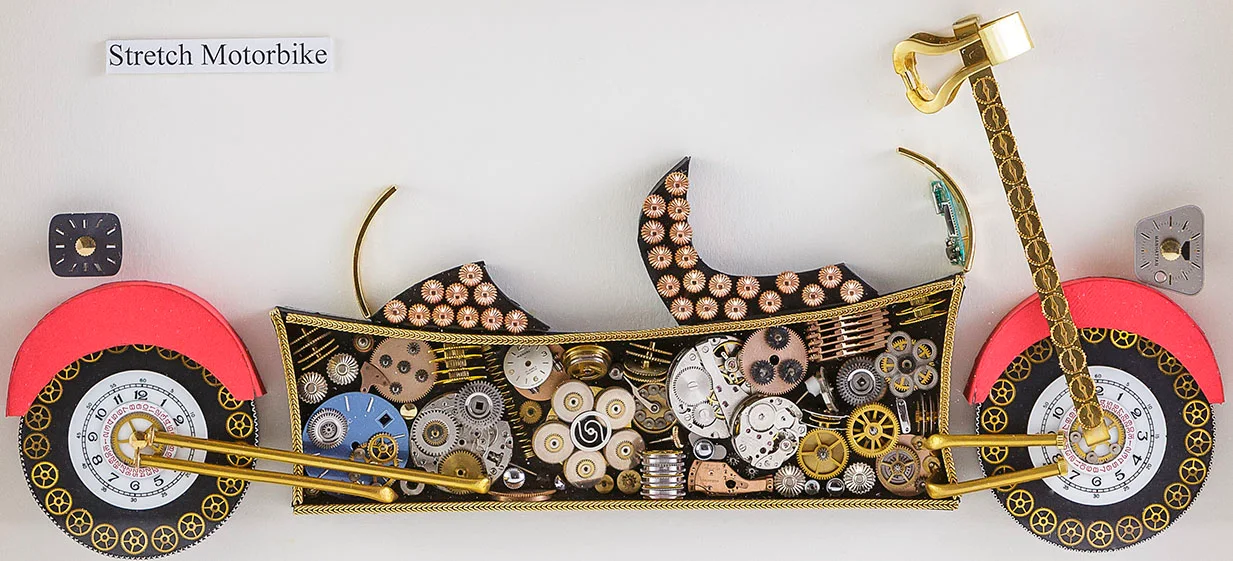
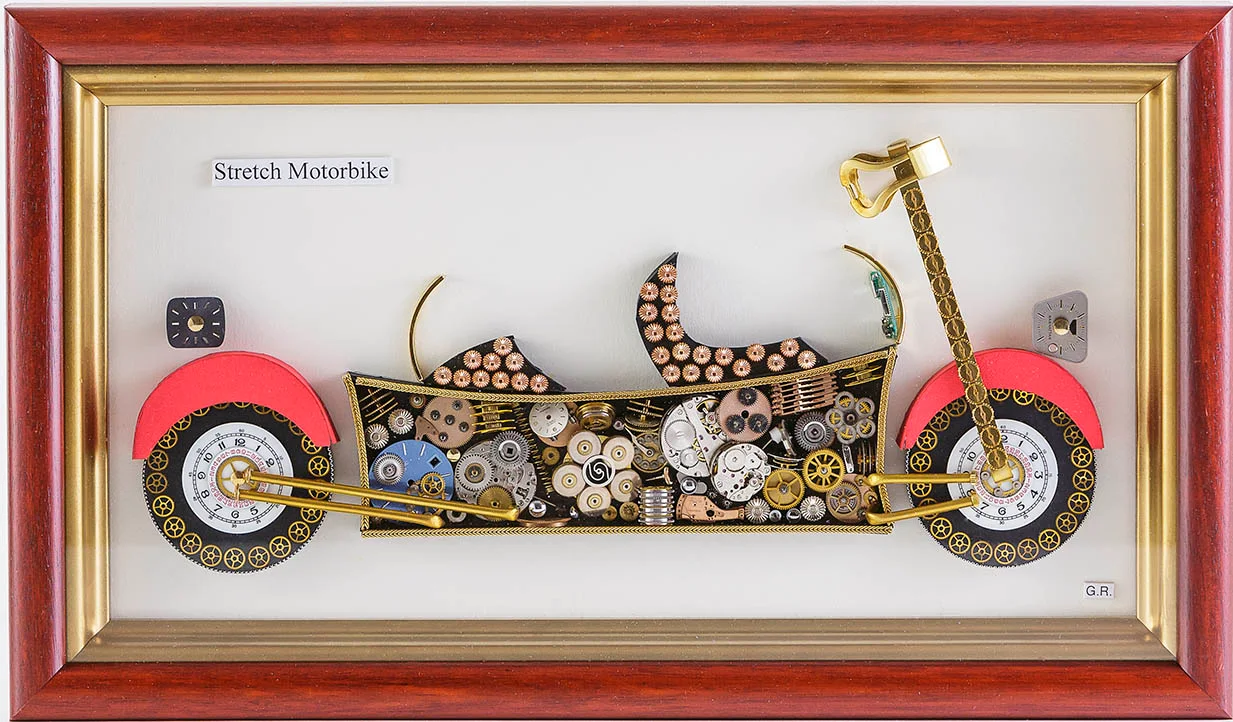
Stretch Motorbike
Instead of a stretch limousine, I created a stretch motor bike - just for fun!
- Collage: Features over 290 watch part components
- Weight: 1.365 kg (3 lb)
- Frame Dimensions: 39.5 x 23 cm (15.5" x 9")
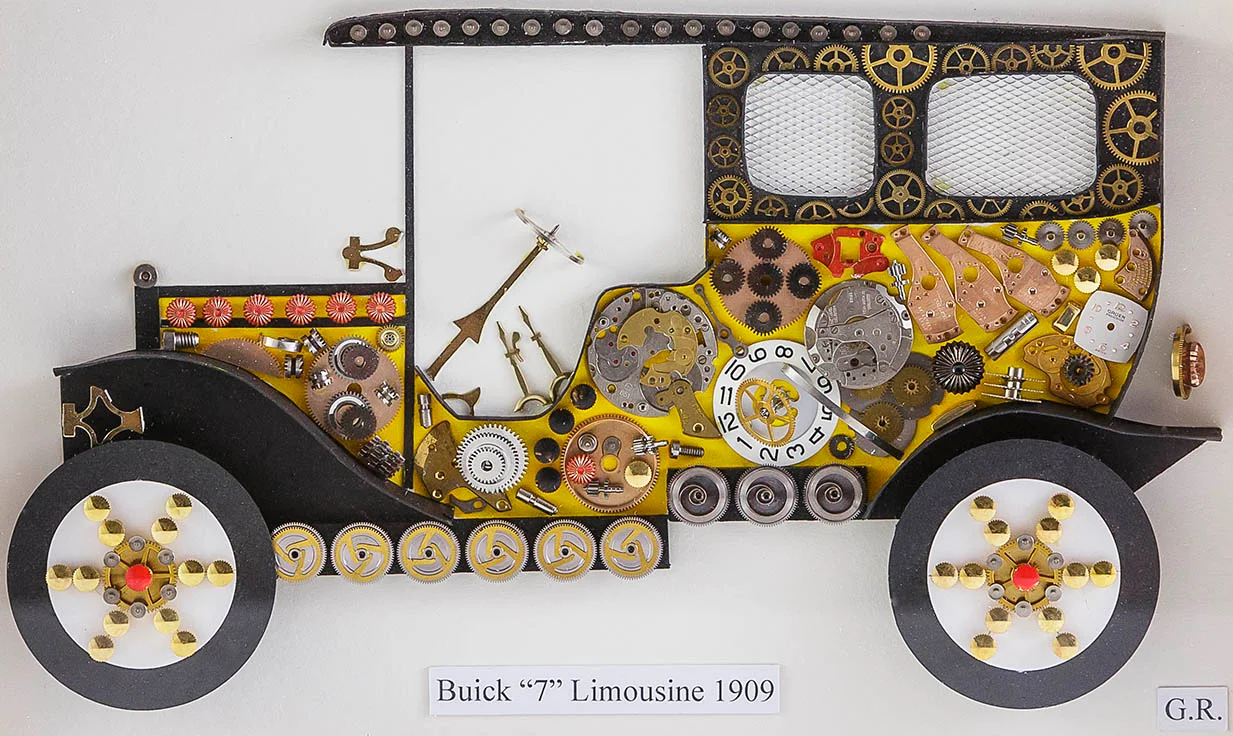
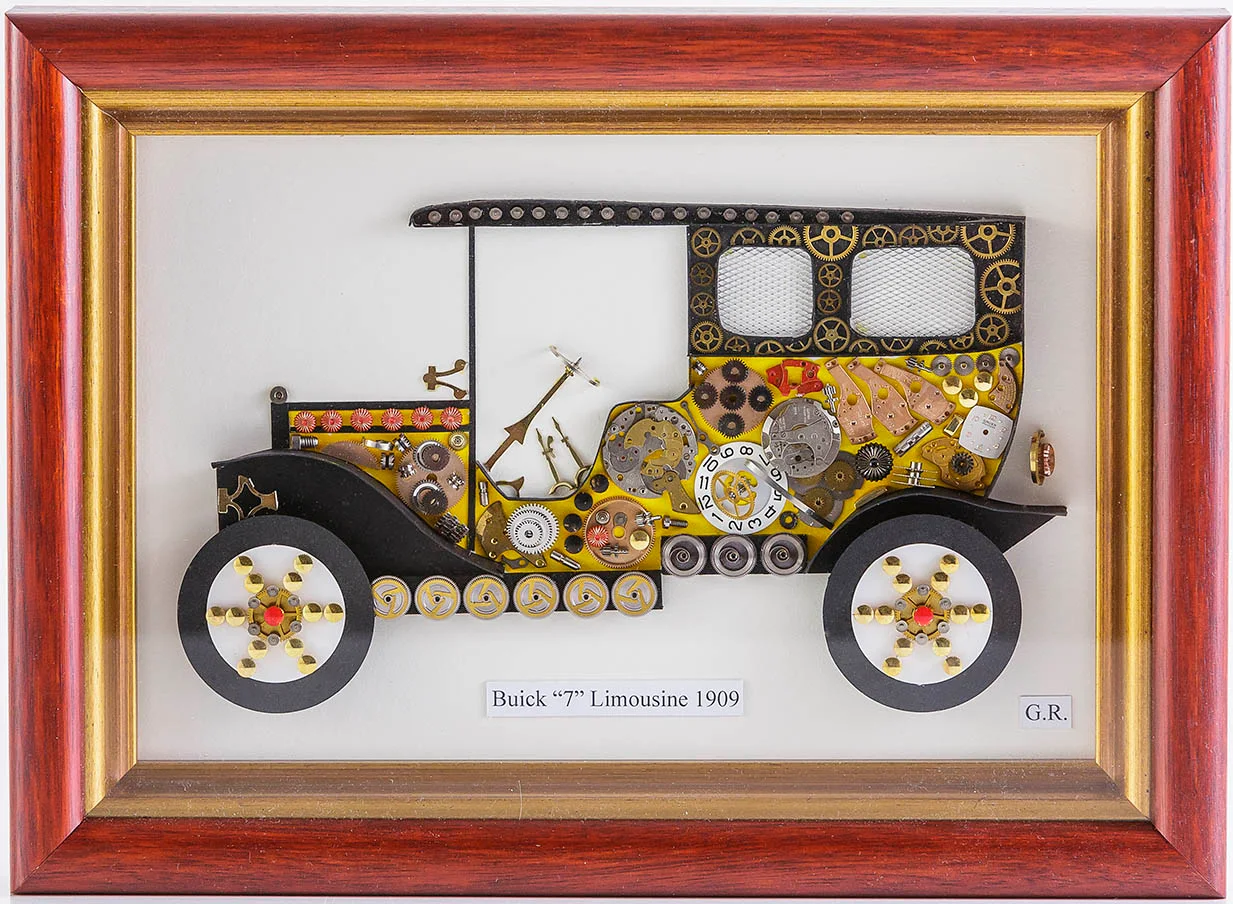
Buick 7 1909
The Buick Model 7 was a luxury car produced by Buick in 1909.
The Model 7 was equipped with a four cylinder in-line motor developing 40 hp of power. The engine was at front, with the traction at back. The motion of the rear wheels was transmitted via a chain.
- Collage: Features over 120 watch part components
- Weight: 1 kg (2.2 lb)
- Frame Dimensions: 30 x 21.5cm (12" x 8.5")
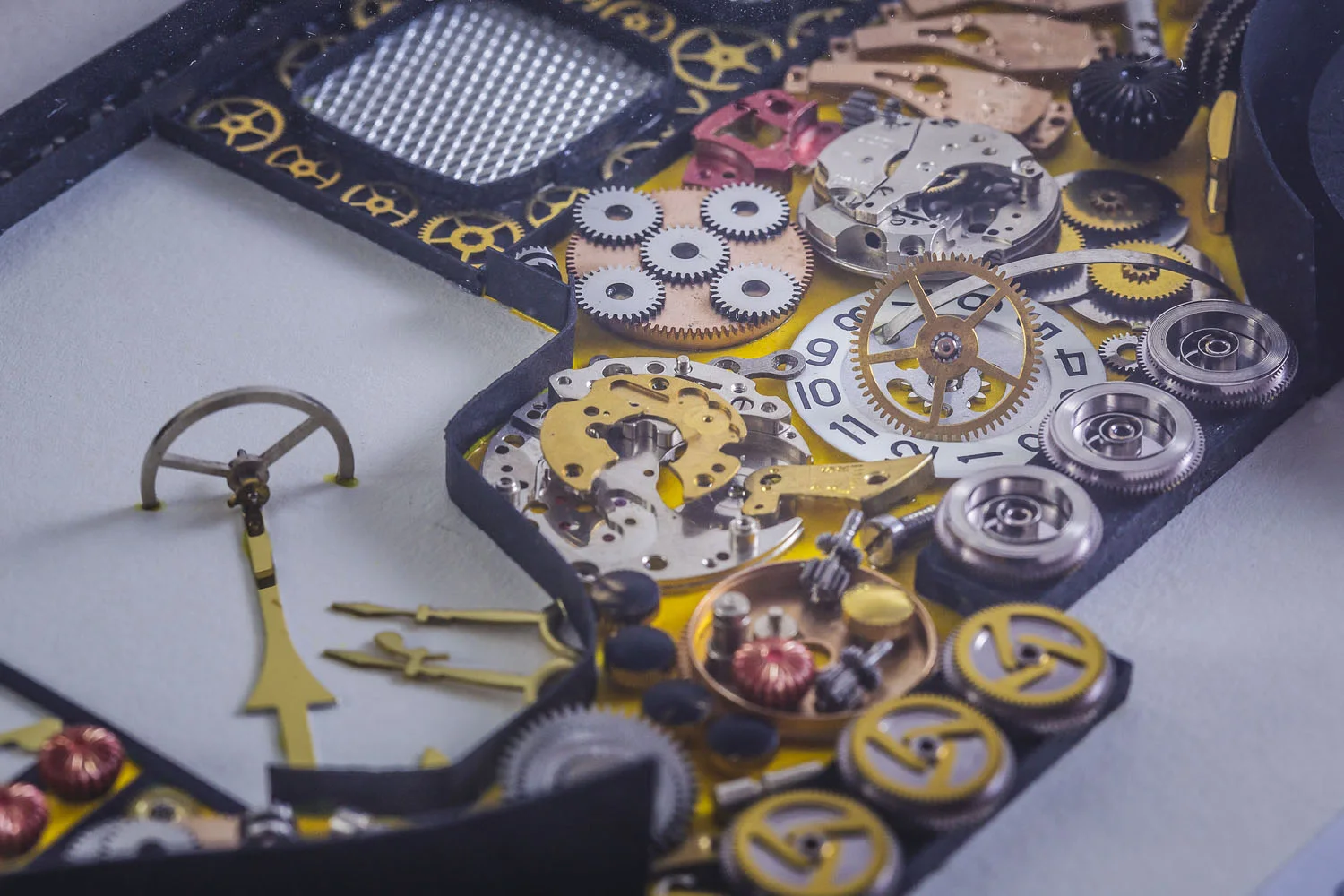
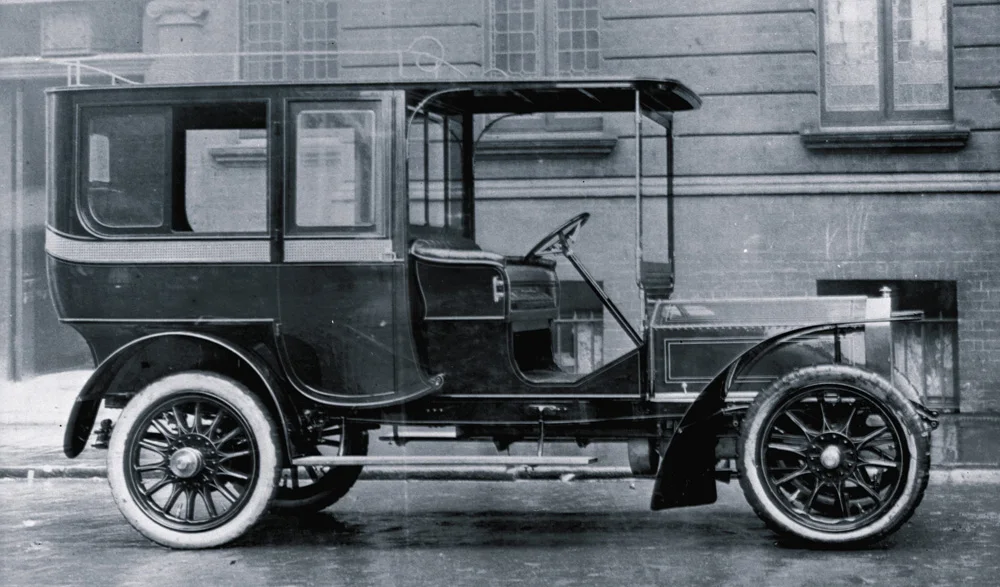
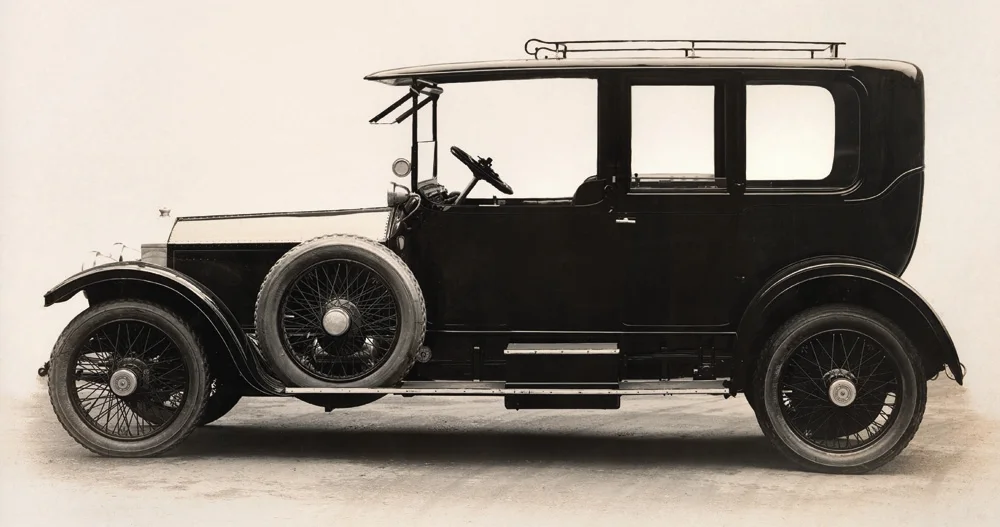
Rolls-Royce Silver Ghost 1906 (Yellow)
In 1906, Rolls-Royce produced four chassis to be shown at the Olympia car show, two existing models, a four-cylinder 20 hp and a six-cylinder 30 hp, and two examples of a new car designated the 40/50 hp. The 40/50 hp was so new that the show cars were not fully finished, and examples were not provided to the press for testing until March 1907.
- Wikipedia: Rolls Royce Silver Ghost
- Collage: Features over 200 watch part components
- Weight: 1.25 kg
- Frame Dimensions: 29 x 21.5 cm
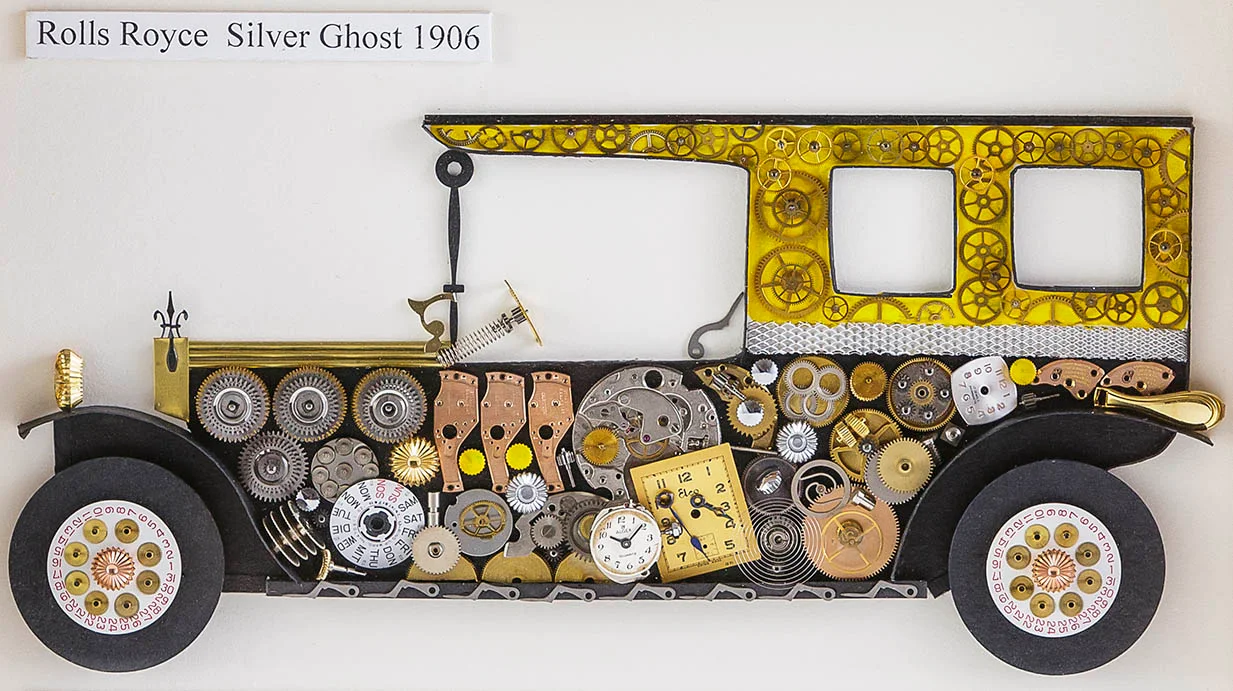
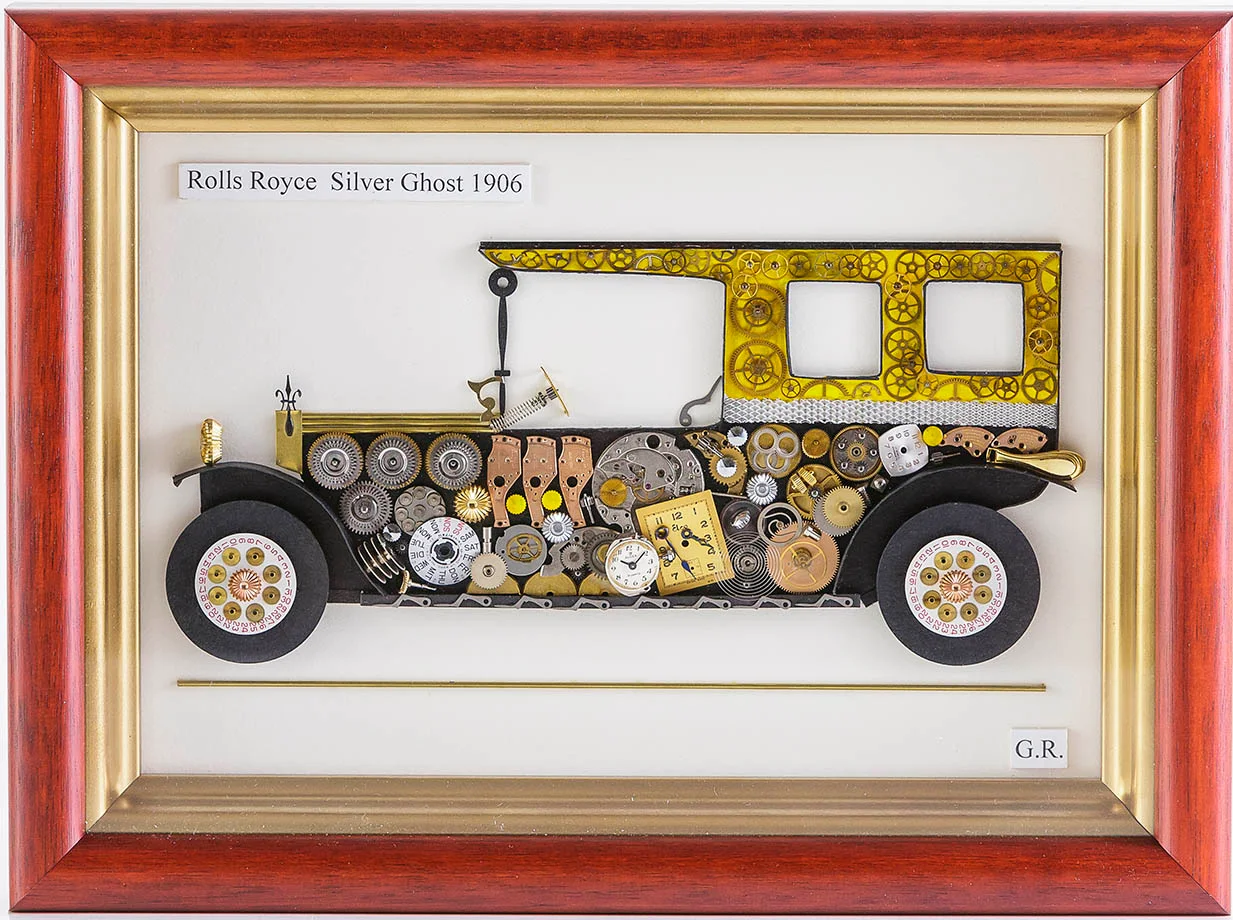
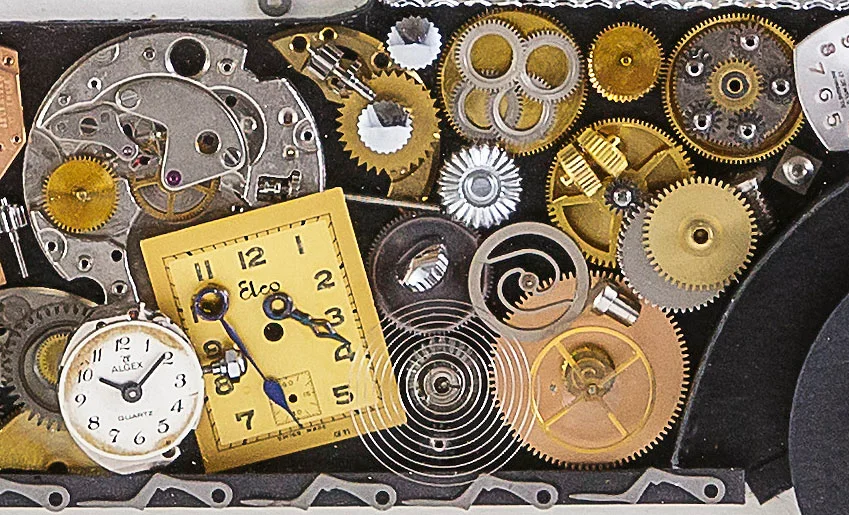
Rolls-Royce Silver Ghost 1906 (Black)
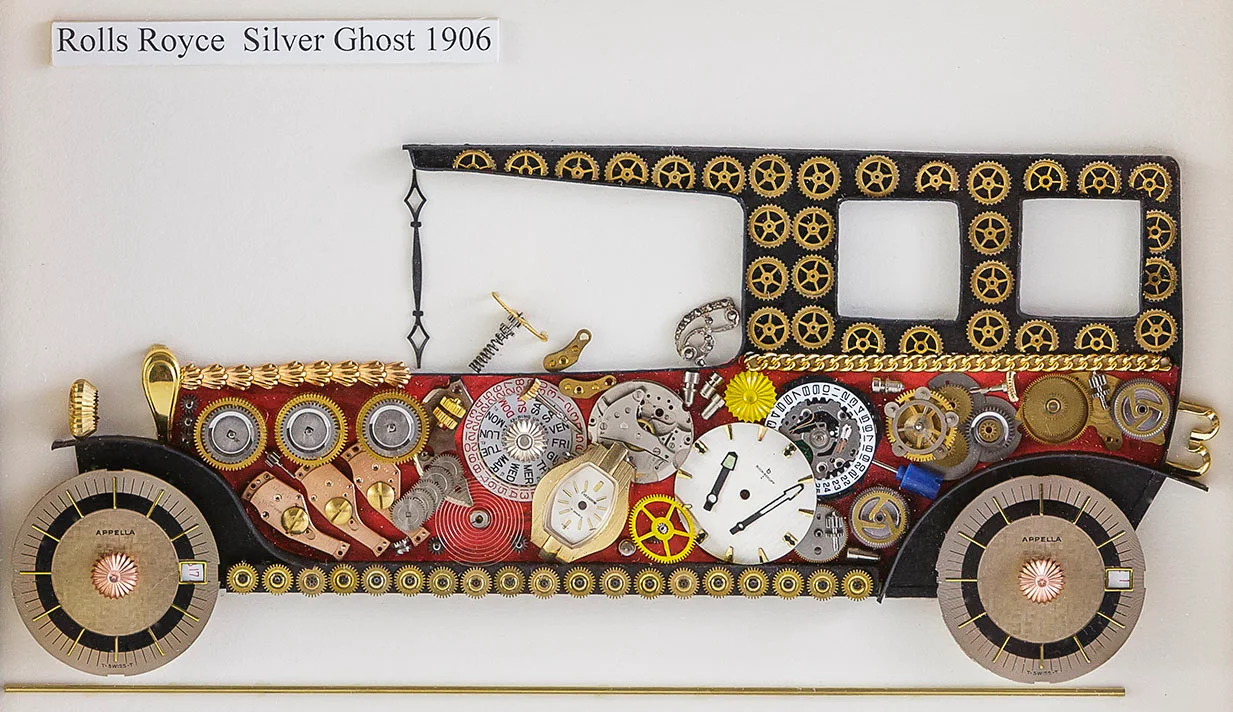
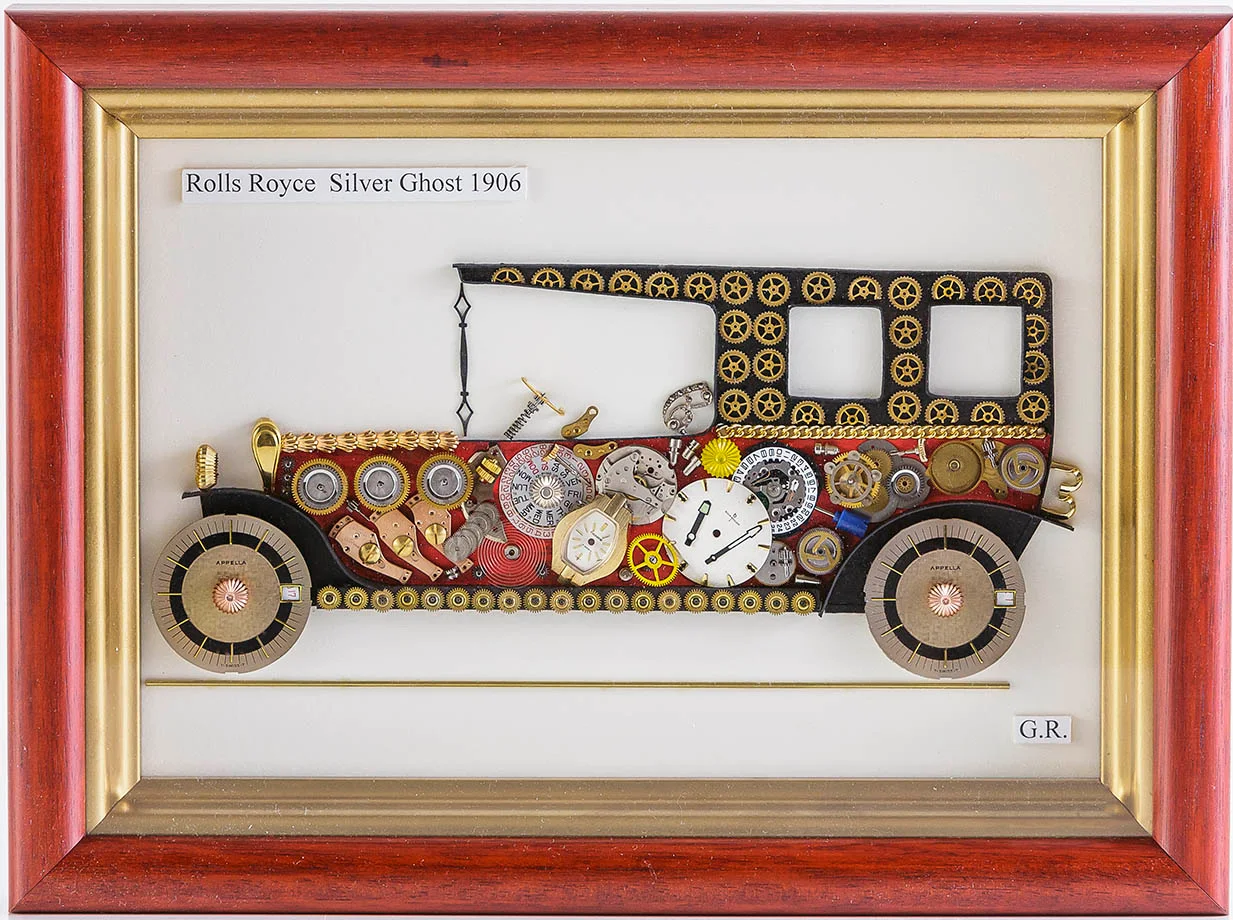
In 1906, Rolls-Royce produced four chassis to be shown at the Olympia car show, two existing models, a four-cylinder 20 hp and a six-cylinder 30 hp, and two examples of a new car designated the 40/50 hp. The 40/50 hp was so new that the show cars were not fully finished, and examples were not provided to the press for testing until March 1907.
- Wikipeia: Rolls Royce Silver Ghost
- Collage: Features over 200 watch part components
- Weight: 1.25 kg
- Frame Dimensions: 29 x 21.5 cm
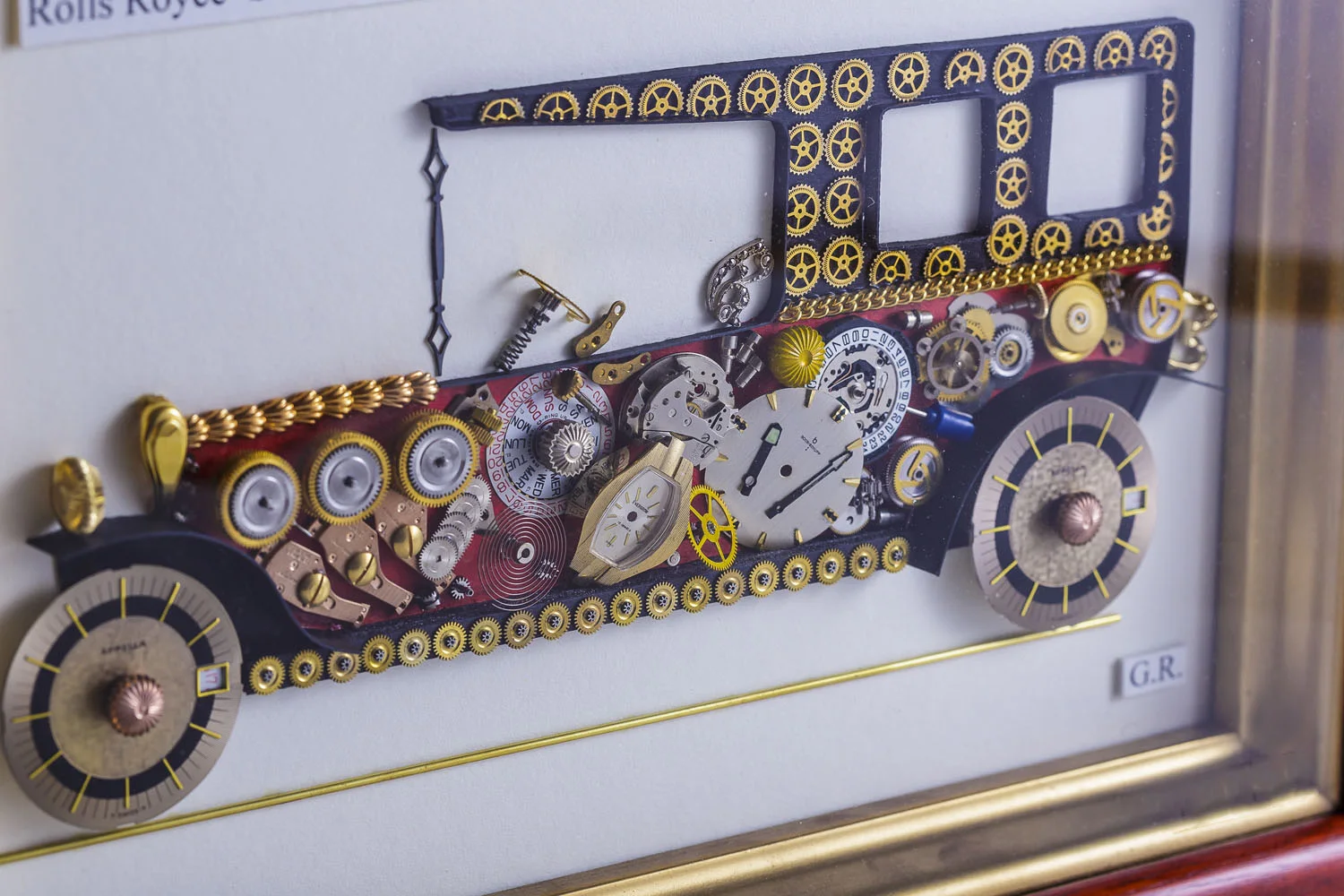
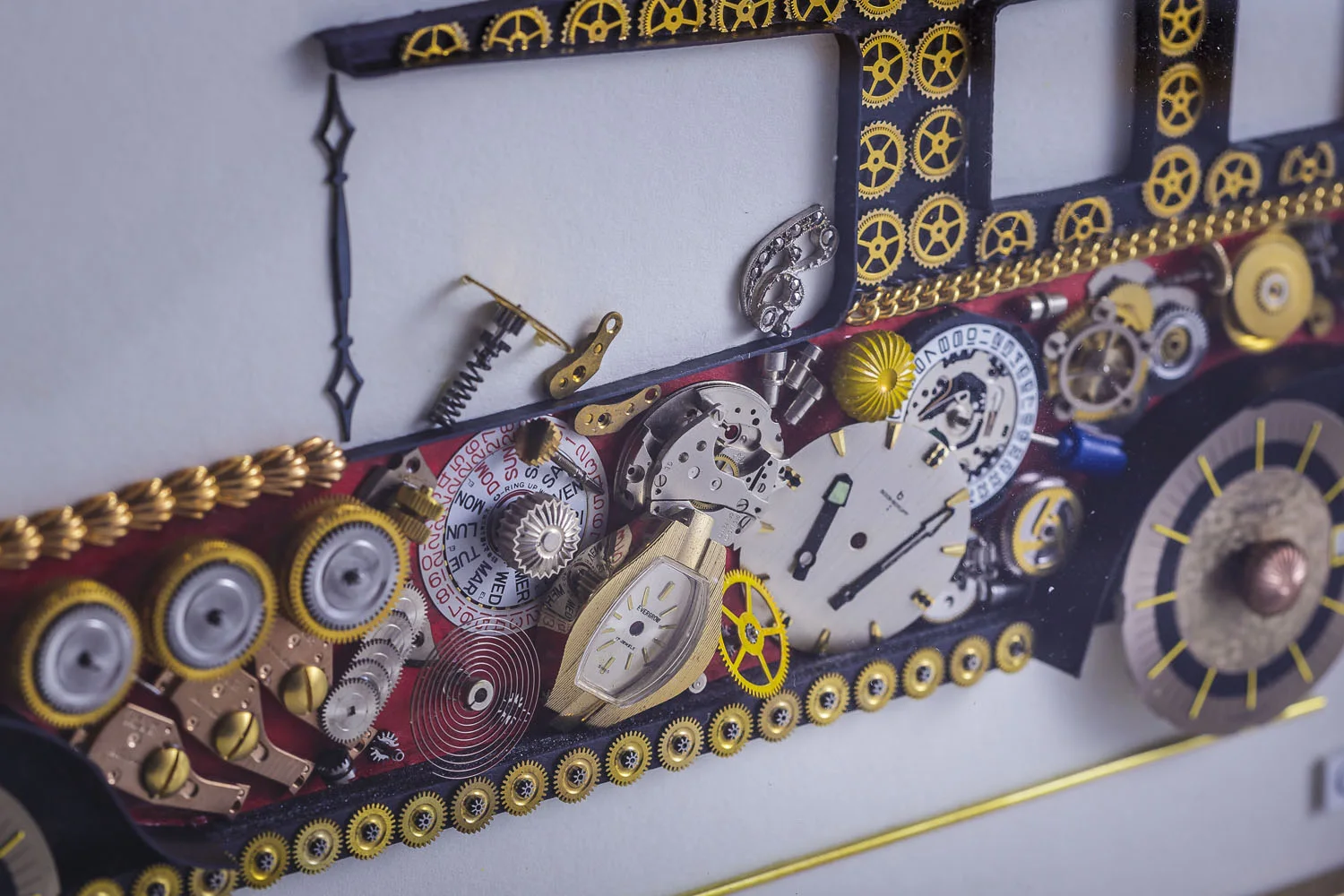
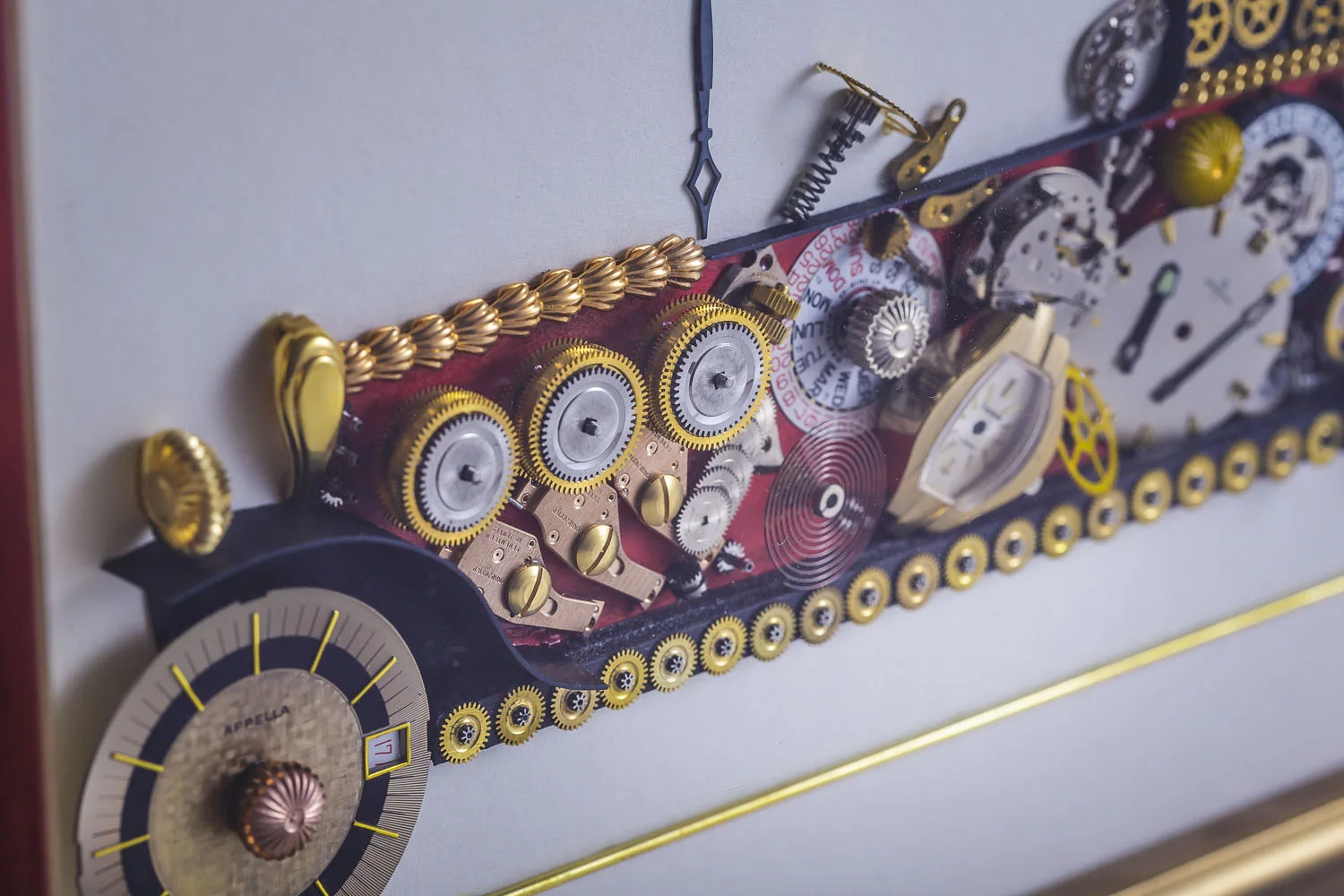
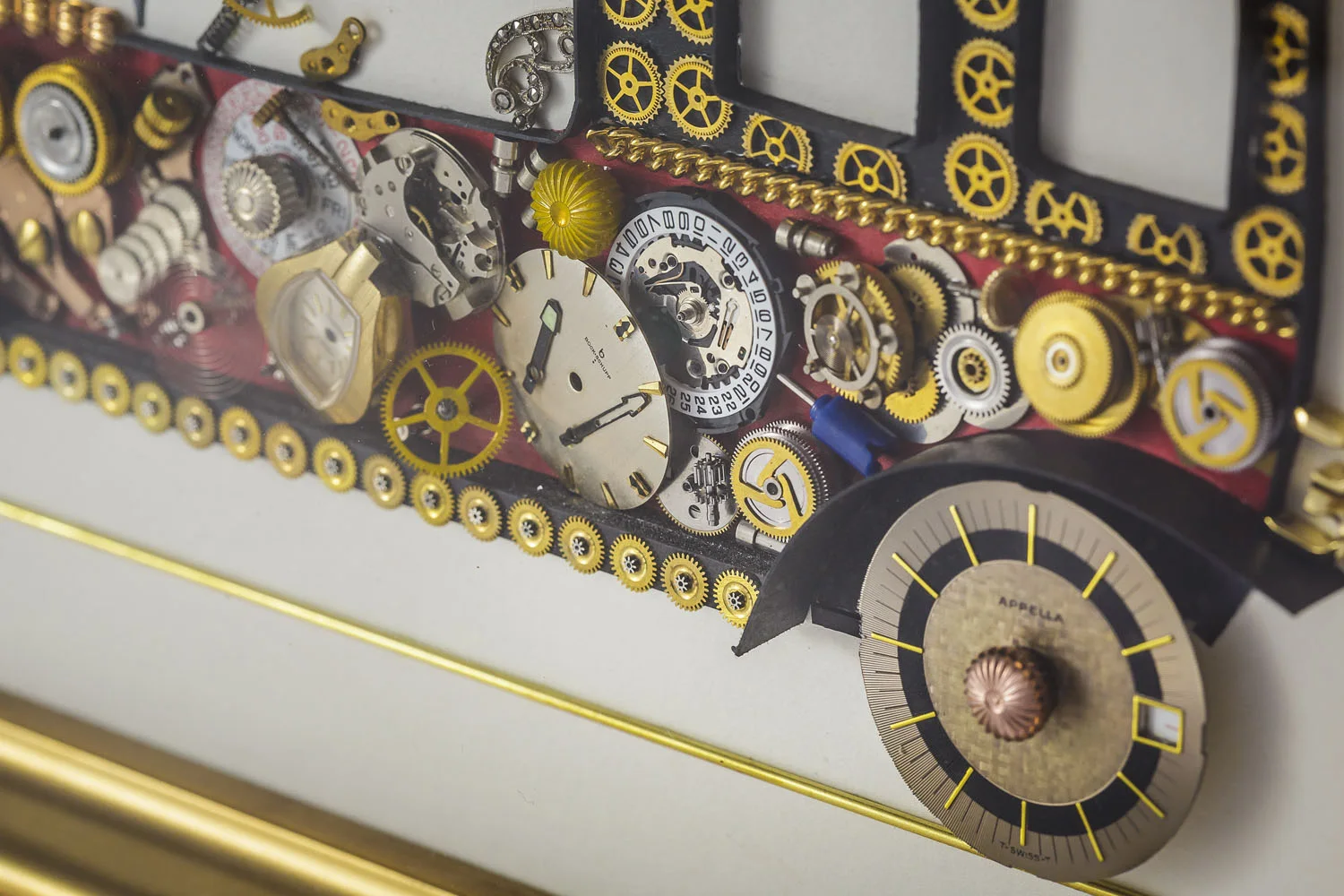
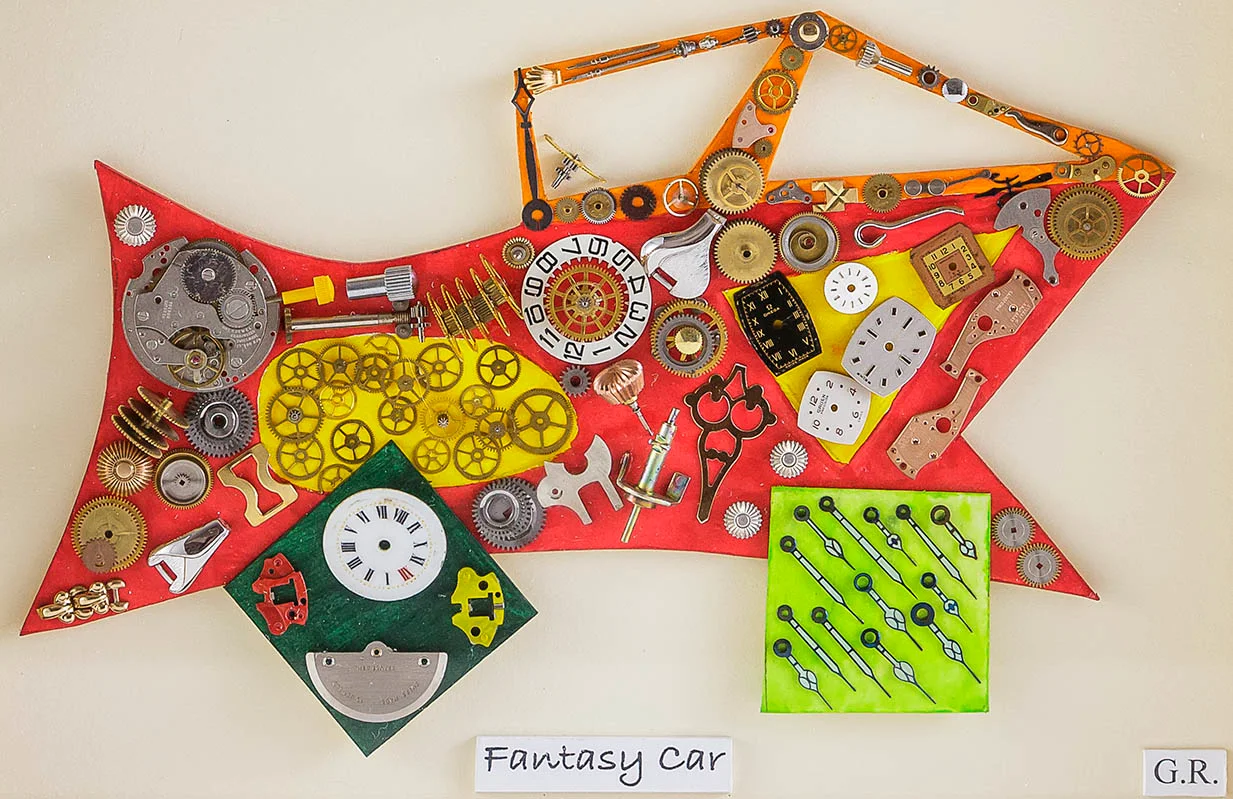
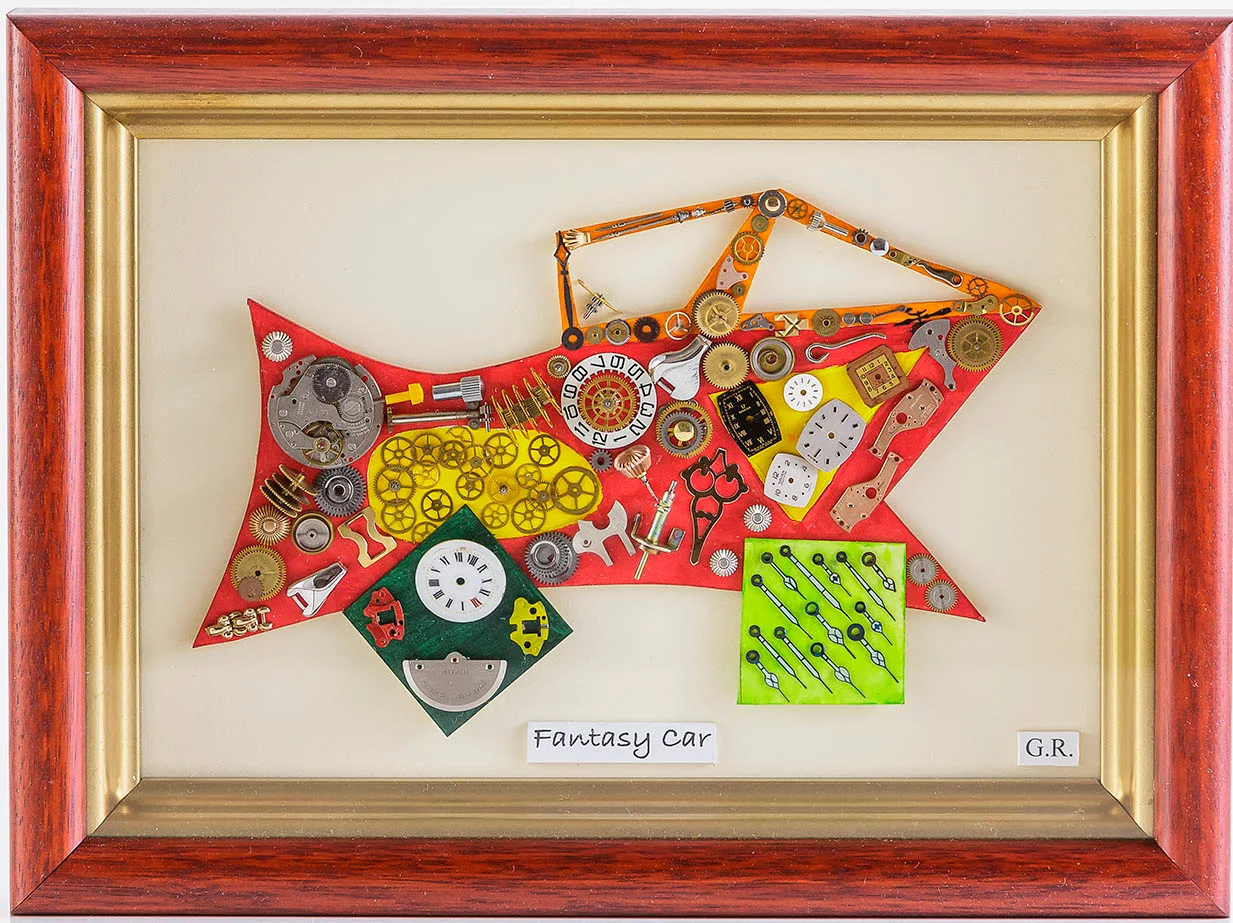
Fantasy Car
Experimental car art, for the car collector who has everything!
- Collage: Features over 160 watch part components
- Weight: 1 kg (2.2 lb)
- Frame Dimensions: 29.5 x 21.5cm (11.5" x 8.5")
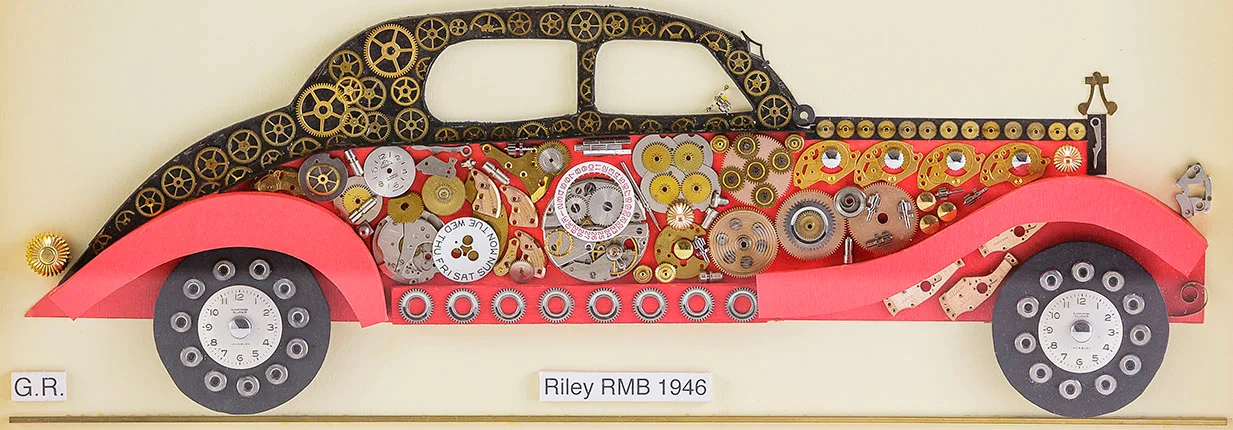
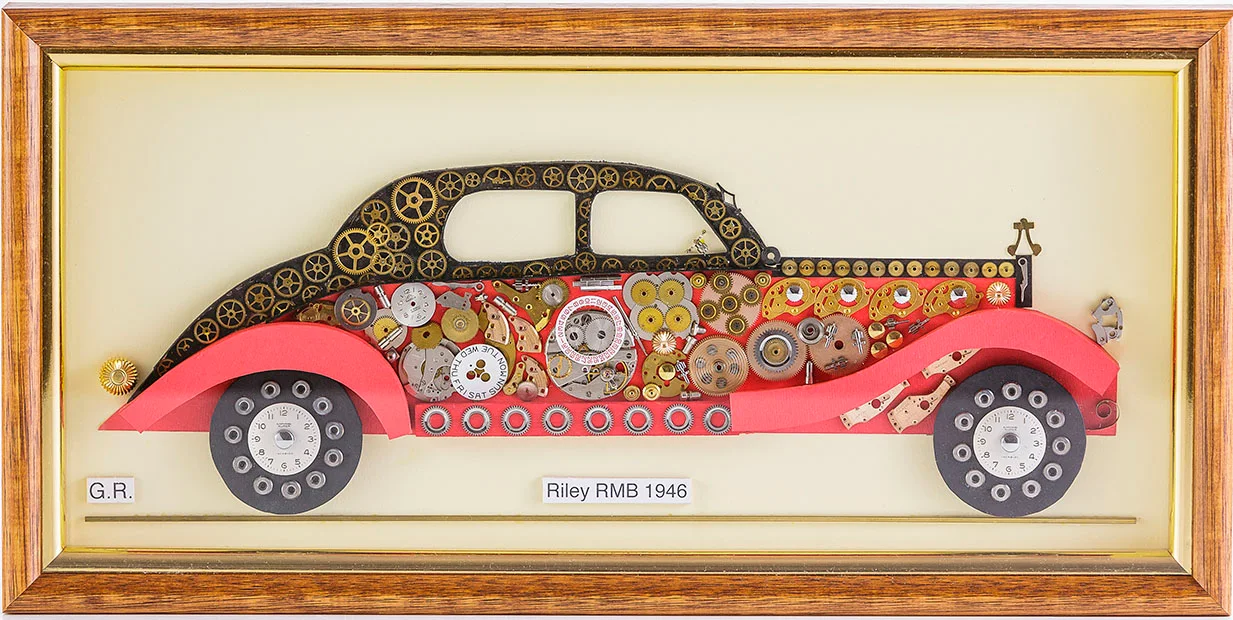
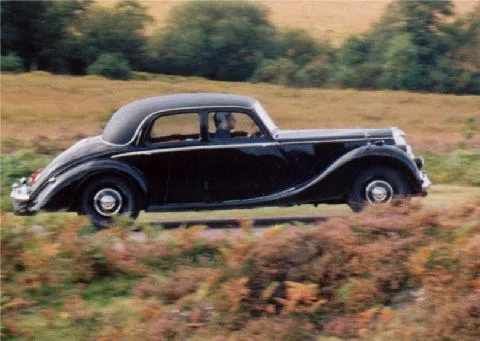
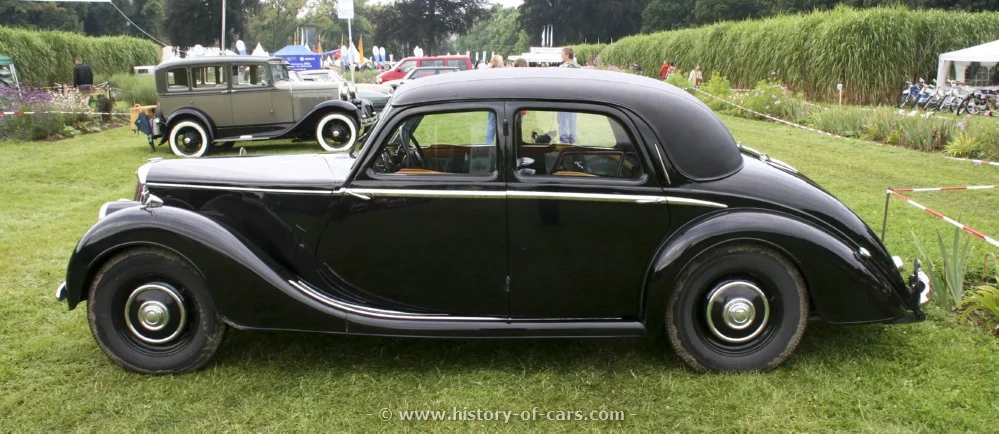
Riley RMB 1946
Riley introduced their 2.5 litre 'RMB' in 1946. Riley's first post-war, full sized saloon, it utilised a wooden from and used a 2443cc, 4-cylinder engine that employed twin SU carburettors to produce an initial 90bhp, with 100bhp available from 1948. Visually similar to the 1.5 litre RMA that was produced alongside it, the RMB was longer overall with a larger wheelbase for greater comfort. Its performance was also far greater, with claims of 100mph being achievable. In 1949 production switched from Coventry to the MG factory in Abingdon, where production ended in 1952 after only 6900 RMBs were produced.
- Collage: Features over 150 watch part components
- Weight: 0.685 kg (1.5 lb)
- Frame Dimensions: 35.5 x 17.5cm (14" x 7")
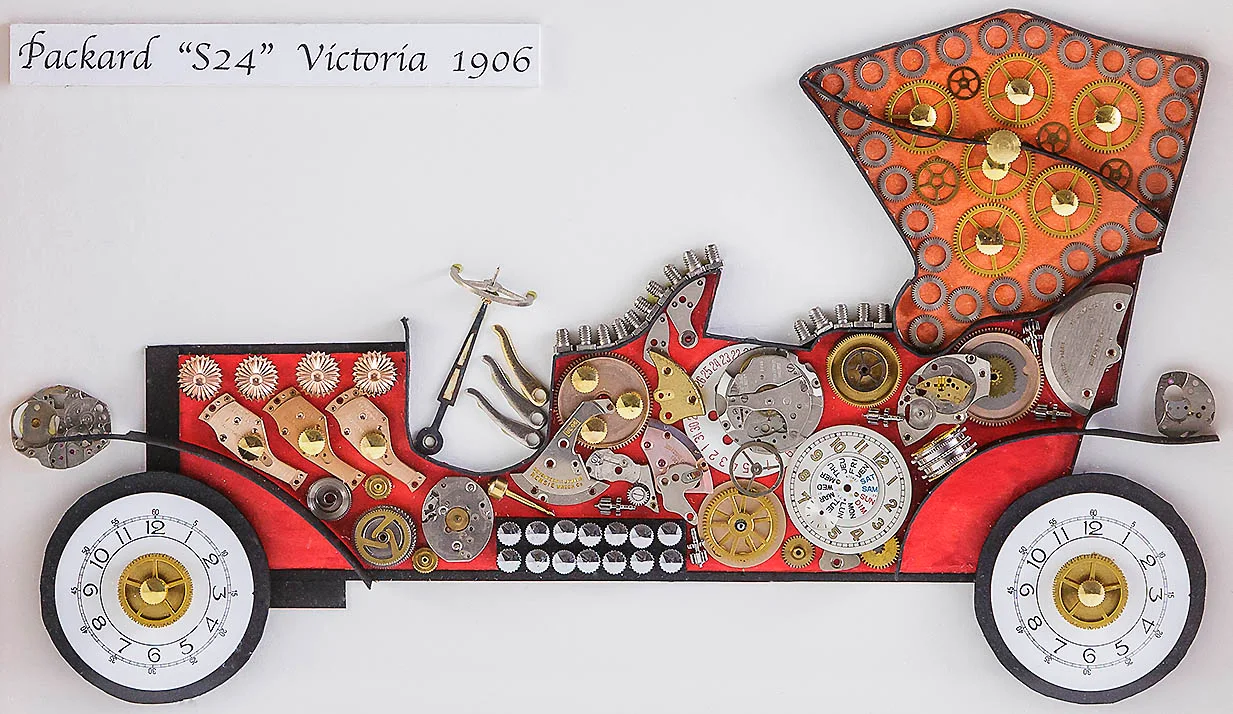
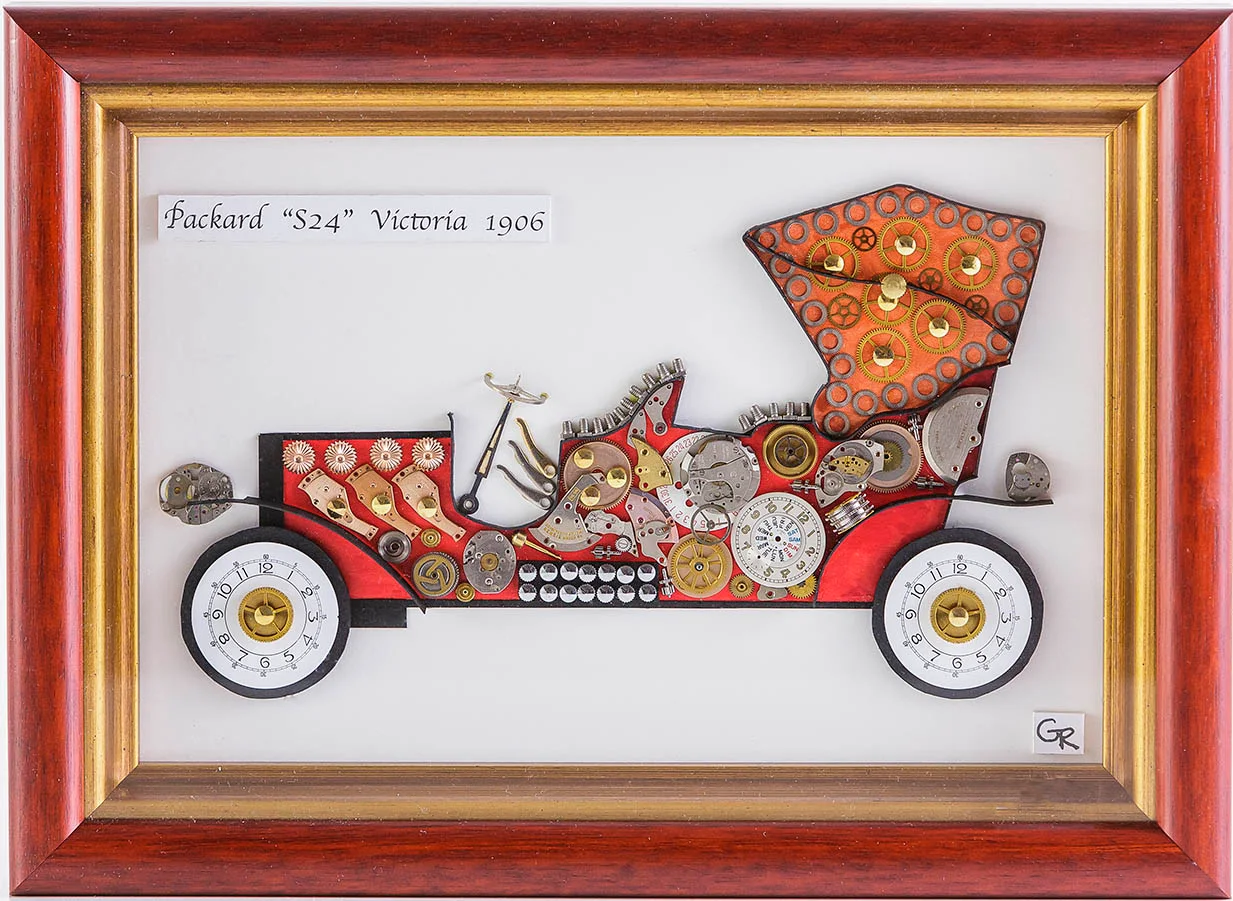
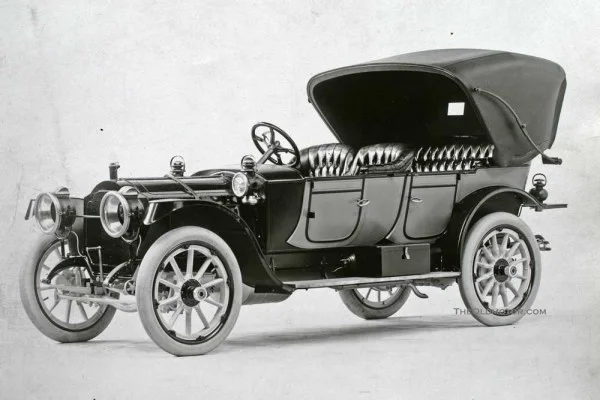
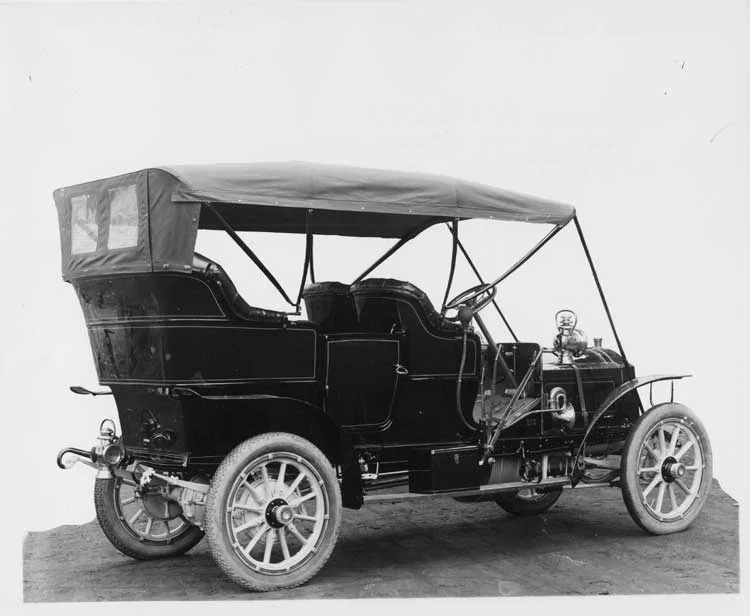
Packard S24 Victoria 1906
The 1906 Model S or as it was also referred to as the Model 24, was slightly bigger with a 4.50″ x 5.50″ bore and stroke, but it was still rated at 24 h.p. while described as being at least 35% more powerful. It was in a 119″ w.b. chassis on 34″x 3.50″ & 4.50″ tires.
- Collage: Features over 120 watch part components
- Weight: 0.84 kg (1.8 lb)
- Frame Dimensions: 30 x 21.5cm (12" x 8.5")
Renault 1910
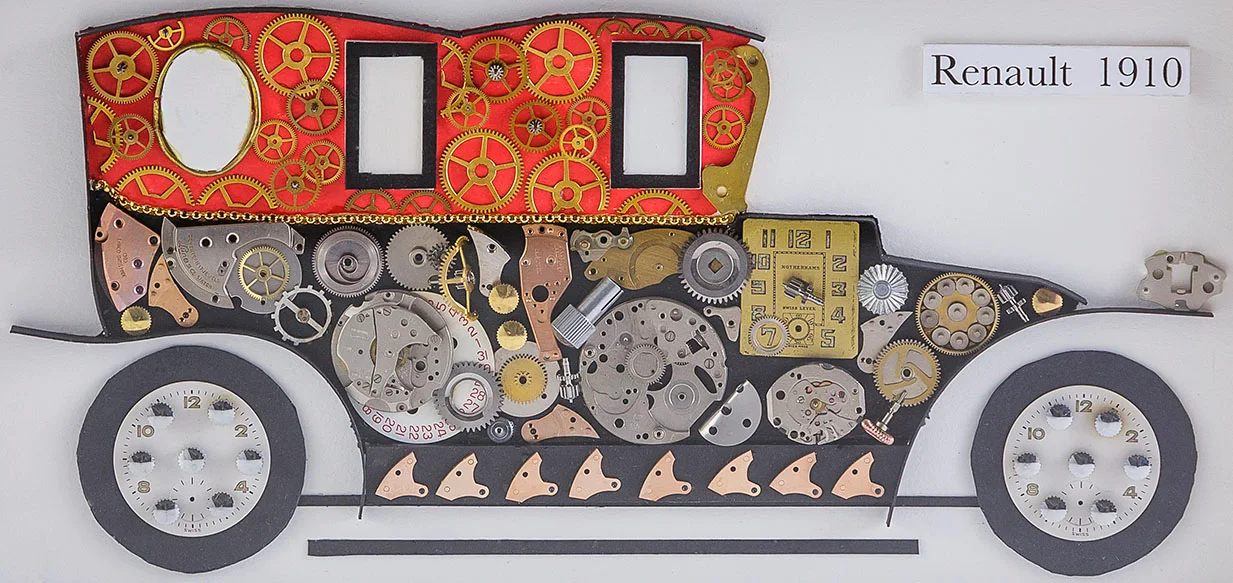
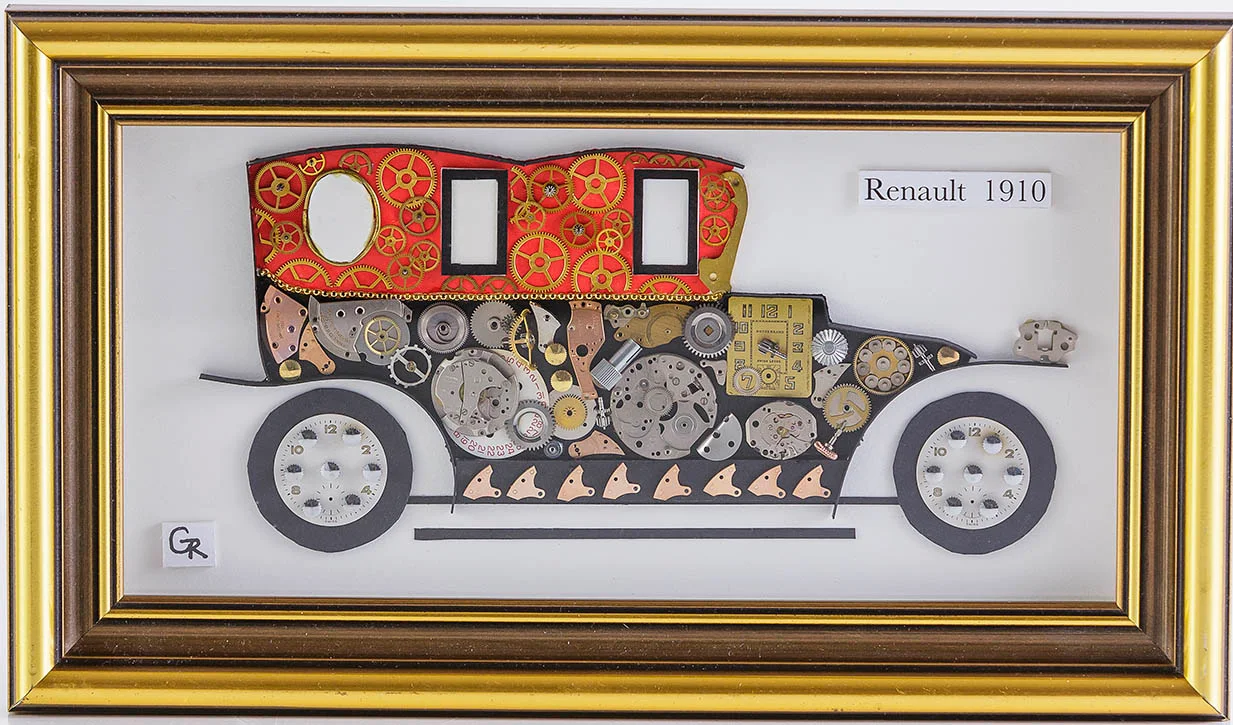
In 1908, Renault unveiled an all-new AX chassis, fitted with a two-cylinder engine. As the most affordable model in the company’s model line, it was an instant favorite among taxi drivers in both Paris and London. By 1910, the AX’s engine was improved with an increase in output to 12 horsepower alongside the introduction of the more affordable AG.
- Collage: Features over 160 watch part components
- Weight: 0.4 kg (0.8 lb)
- Frame Dimensions: 27 x 15 cm (11" x 6")
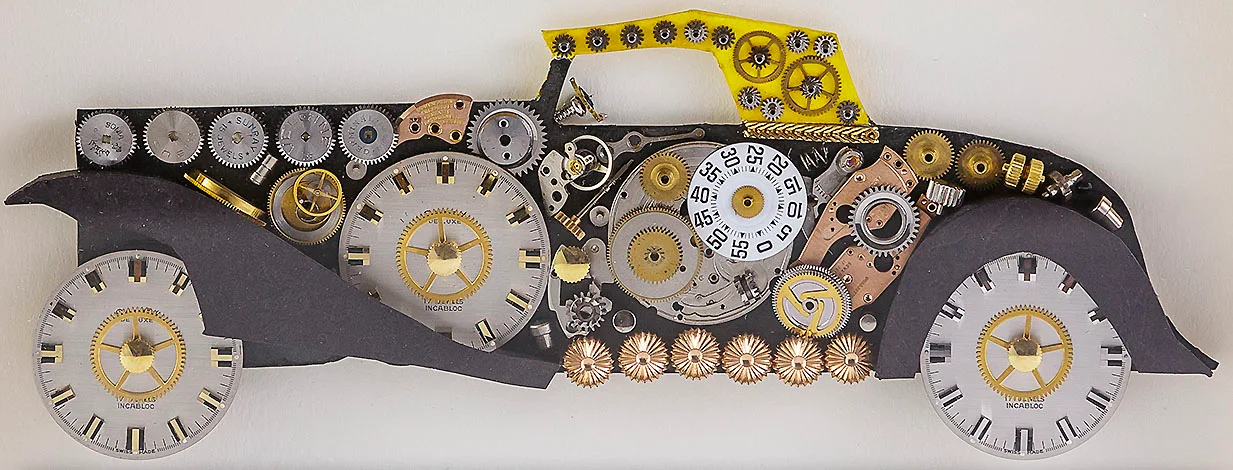
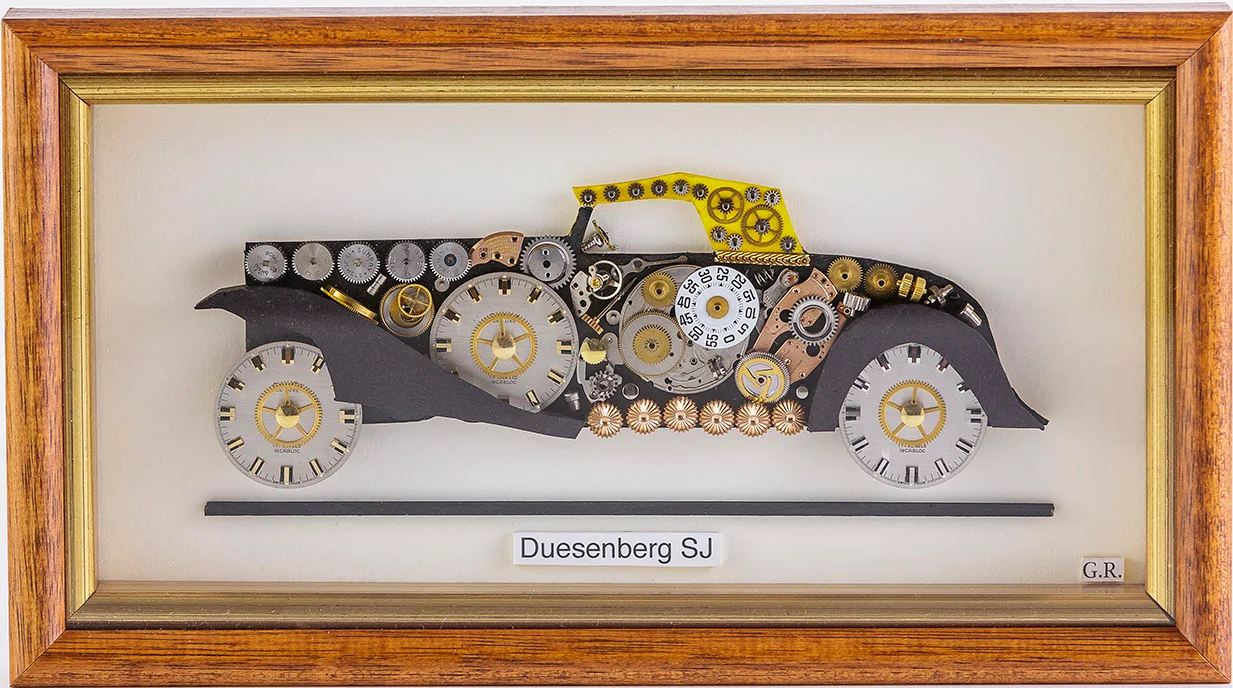
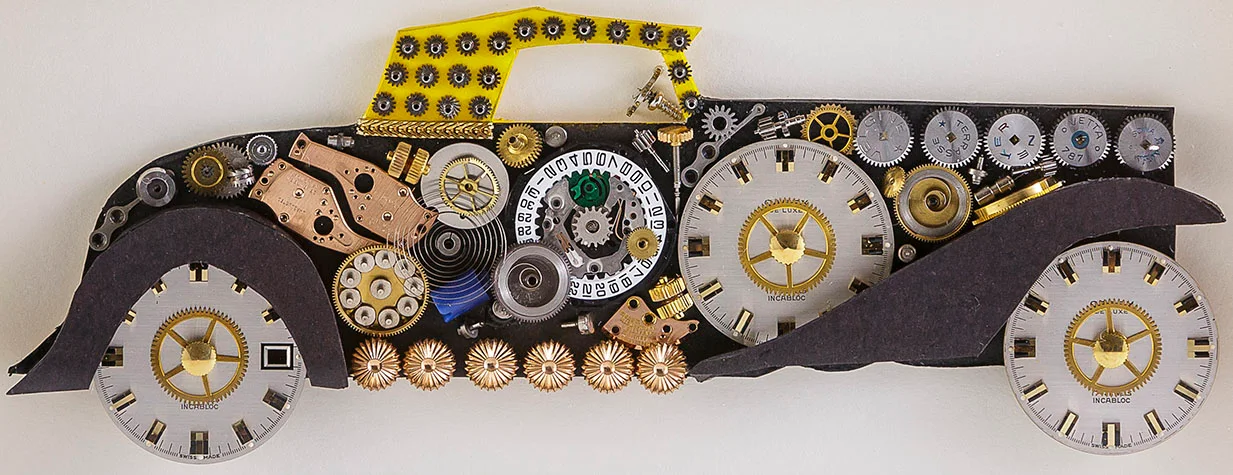
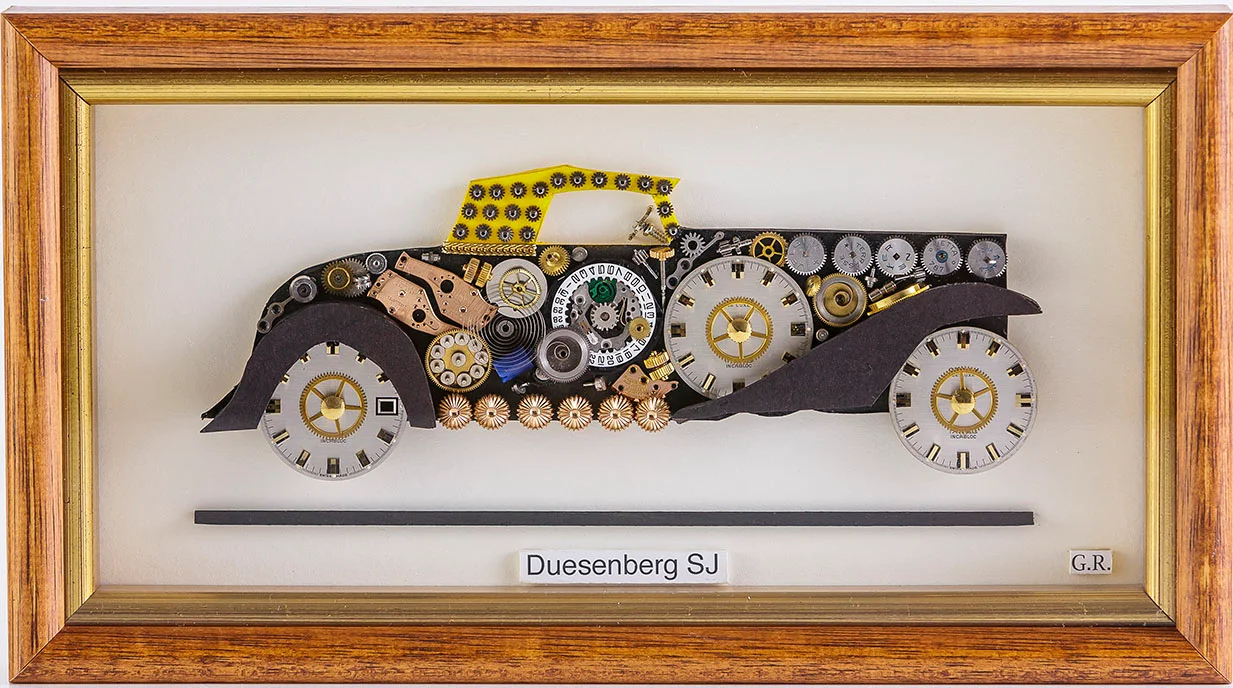
Duesenberg SJ
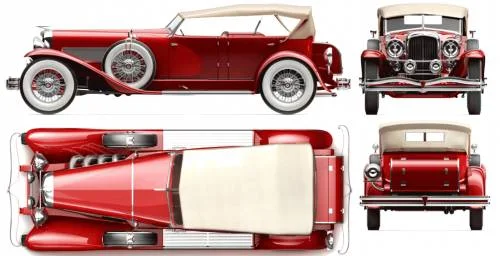
The Duesenberg Model J was a luxury automobile made by Duesenberg. Intended to compete with the most luxurious and powerful cars in the world, it was introduced in 1928, the year before the stock market crash that led to the Great Depression.
- Collage: Features over 80 watch part components
- Weight: 0.28 kg (0.6 lb)
- Frame Dimensions: 24.5 x 13.5 cm (10" x 5")
Commissions
Custom-Designed Collage
Would you like a custom-designed collage for your special occasion?
Contact us to discuss what is possible.
Enquire about a collage